Fishing

Trout Country: Reflections on Rivers, Fly Fishing & Related Addictions

Bob Saile, Trout Country: Reflections on Rivers, Fly Fishing & Related Addictions.  Pruett Publishing Co., Boulder, Colorado 1999.   My favorite quotes or summaries are as follows: Aside from the Brassie, the most important contribution to the fly boxes of American anglers to come from South Platte lore is the RS-2 —an all-purpose nymph pattern that, depending on size, can resemble the aquatic stages of a midge, a mayfly, or even a caddis.  RS-2 stands for “Rim’s Semblance, Style 2.”  It was born in the tying vice of Rim Chung of Denver, a self-taught fly fisherman who began as a frustrated spin-fisherman. When Chung came to Colorado from Seoul, South Korea, in 1968, he had a strong desire to catch Colorado trout but only the weakest clues on how to go about it.  He began to fish with spinning tackle but rarely caught anything when he encountered the selective trout of the Platte and other waters.  Two years later, he was ready to give up.  Then a friend suggested he take up fly-fishing.  “What the hell is fly-fishing?” Chung asked his friend.  Chung then began to fish with dry flies, but it was still frustratingly unproductive or, at best, inconsistent.  Finally he met someone who offered to take him nymph fishing.  “What the hell is nymph fishing?” Chung asked. His progression to becoming a successful trout fisherman was fairly swift after that.  Chung developed his nymphing skills and learned to tie flies.  He decided to try to develop a nymph pattern that was a general suggestion—a semblance—of almost any hatching aquatic insect, depending on size.  What emerged was a pattern that is constructed with a Tiemco 101 hook that has a straight eye, in sizes as big as 14
By |October 12th, 2011|Categories: Fishing, Fly Tying, Rim Chung, RS2|Comments Off on Trout Country: Reflections on Rivers, Fly Fishing & Related Addictions

Standing in a River Waving a Stick

Standing in a River Waving a Stick, New York: Simon & Schuster (1999) by John Gierach My favorite quotes or summaries from this book are: This business of changing fly patterns, looking for the right one, is central to the sport. All of us, secretly or otherwise, believe it’s the fly that makes the difference, although we’ll admit that even the right fly has to be cast accurately and drifted properly to work.  Still, when someone is catching more fish than we are --- and when we’re not too embarrassed to ask--we say, “What fly are you using?” as if that one bit of information was all we needed. Okay, but if you ask three different fishermen you’ll probably get three different answers, so you have to suspect that although the knowledge passed on by other fly fishers is a great gift, the true solution is somehow yours and yours alone.  Everyone I know who has fly fished for long has theories about fly patterns, all of which sound reasonable enough on a long drive or around a campfire.... The choice of a fly pattern for nymphing can seem too huge to comprehend, and I’ve seen nymph fishers standing like zombies on riverbanks, gazing into open fly boxes, literally frozen by indecision.  (I recognize that when I see it because I’ve done it myself.) The thing is, aquatic insects spend most of their lives on the stream bottom, where they are regularly eaten by trout.  Mayflies and stone flies have a nymphal stage.  These are six-legged, armored bugs that fly fishers think are handsome but I heard one non-anglers describe as looking like wet cockroaches. Caddis flies and midges have bottom-dwelling larval stages that run into pupae

By |October 9th, 2011|Categories: Book Reviews, Fishing, Fly Tying|Comments Off on Standing in a River Waving a Stick

Hunt, Gather, Cook

Hank Shaw is an award-winning journalist and makes his debut from his blogger's guide to a book on foraging, fishing, hunting, simply entitled Hunt, Gather Cook--and makes the most of the fruits of a day spent gathering food in the field. His blog, Hunter Angler Gardener Cook, has developed an avid following among outdoor people and foodies alike. Hank Shaw's blog, Hunter Angler Gardener Cook, and which is more impressive than the book, can be found at: http://honest-food.net/ His poacher's blog, which is also worthy of mention, despite his bad-form tactics, can be found at:  http://huntergathercook.typepad.com/

By |October 8th, 2011|Categories: Book Reviews, Cuisine, Fishing, Recipes, Wingshooting|Comments Off on Hunt, Gather, Cook

Smoked Salmon Bagel Sandwiches

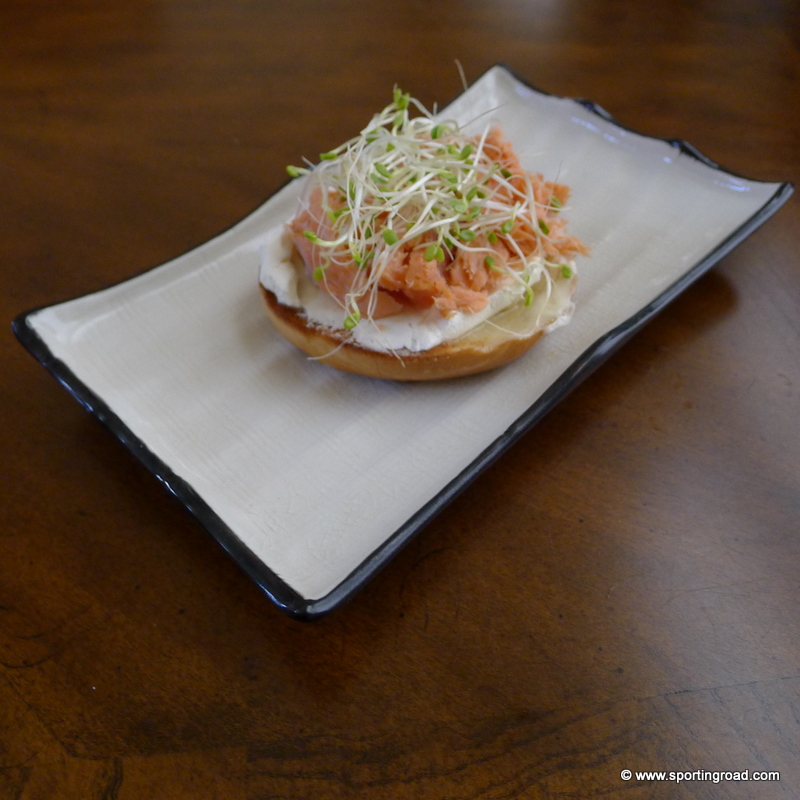
Lox is a cured salmon fillet, usually sliced thin.  Typically it is served on a bagel, often with cream cheese, onion, tomato, cucumber and capers. Lox can be crumbled into small pieces and added into scrambled eggs, sometimes with chopped onion. I have to confess, I never much cared for lox.   At least, not when compared to freshly caught and smoked salmon, as lox is far too often too dry or too salty.  Freshly smoked salmon is better, especially if you caught it yourself, fly fishing. While the Kokanee salmon run is on here in Colorado, we like to keep a few for smoking, as they die in their breeding rituals within the month of their run up the river anyway, so it seems a waste not to take advantage of their great flavor. And, the Togiak River is quite possibly the best King and Silver Salmon river in Alaska, from which our friend, Rim Chung, had just returned with some its delicacies. Numerous anglers who have fished all over the world describe the Togiak as incomparable for its salmon runs, as well as for its nearby trout and grayling fishing. All of the Alaskan and Northwest wild salmonoids are worth smoking, whether it is the Copper River salmon from your market, or something farther down the Sporting Road. We like our smoke salmon flaked on a hot, buttered bagel, topped with cream cheese and sprouts.  It doesn't get simpler than this, nor better.  Voila!

By |October 3rd, 2011|Categories: Cuisine, Fishing, Recipes|Comments Off on Smoked Salmon Bagel Sandwiches

Fly Fishing La Loue in the Jura

The French Jura region bordering Switzerland are beautiful and amazing, even for those of us living in the shadows of the  Rocky Mountains.  The streams in the Jura deserve their reputation as the best in France. Excepting the fame created by Charles Ritz's writings of the chalk streams of Normandy, the Jura is one of the rare regions in France with an international fly fishing reputation. There are many places that I fell in love with in France, but the Jura has something special and unique--the landscapes, the rivers, trout and grayling, the fly fishers and even the flies. Add the hospitable nature of the people, warm welcome at the hotels, and the rich and original gastronomy, lexapro. It is one of the few regions which produces both good cheese and good wine, which is rare to have both in France due to the differing climates required for dairy cattle versus grape production.   The scenery is spectacular, from the river valley to the high plateaus.  Sightseeing the source of the Loue is worth the short drive and hike.  Also, the trips to the neighboring towns along the valley, prove to have enough to interest everyone from shopping, sightseeing, gourmet shops for the famed Comte cheese, local wine suppliers offering great wines at very inexpensive prices, and quaint outdoor cafes for a anise-flavored pastis to cool ourselves and warm our hearts.  Parts of the valley reminded me of Venice where the river meets the houses built on stilts. Enough of the setting, let’s get down to fishing.  The only downside to fishing the Jura is that the local fishing rules are impossible to understand, even for the locals (even Nick de Toldi, who guides there regularly, promised they would be

By |October 2nd, 2011|Categories: Fishing, France, Travel|Comments Off on Fly Fishing La Loue in the Jura

The International Fario Club

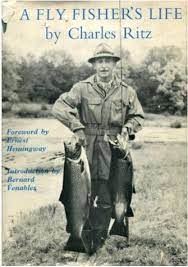
Charles Ritz, of the Ritz hotel fortune, spent considerable time studying the art of fly fishing in the American West, England, and France.  His book, A Flyfisher's Life, is one of the few books in the English language discussing fly fishing in France. In the 1930's he became an authority on fly fishing in France and invented the parabolic fly rod, which is still used, and which was commercially produced by ABU Garcia.   Mr. Ritz was an advocate of the high speed - high line style of fly casting. He founded the "Fario Club", which was the most select fishing club in the world during the later part of the twentieth century and remains so today.  We enjoy regular gatherings in Paris and around the world, to enjoy the camaraderie of others similarly suited. The Club's website is presently being revamped, but it can be found at www.farioclub.org.  The "Pays d'Auge" region is made up of the port towns two hours north of Paris, including Honfleur, Deauville and Trouville. It takes like two small hours to drive from Paris.  After driving through the lush fields where dairy cows are milked for production of Camembert, Pont-Lévèque & Livarot, and passing apple tree after apple tree, so it is no surprise that Calvados is offered at every turn in the countryside, we followed in Charles Ritz's footsteps staying the same place he did at the mill of Aclou on the river Risle.  The "Aclou Reach" is often mentioned as his favorite fishing spot, home to the brown trout. Pezon Et Michel Ritz Super Parabolic PPP Fario Club bamboo fly rod. This rod is 8’ 6” long and it is rated for 5-6wt fly lines.

By |October 2nd, 2011|Categories: Fishing, France, Travel|Comments Off on The International Fario Club

New Posts

Please check out all my new posts...which are hidden under separate pages and therefore don't show up here.  Kohlrabi Mardi Gras La Buche de Noel Noel House Wine Hungarian Partridge with Gin & Juniper Berries Pheasant Confit Four-legged Friends Gary Ruppel Rim Chung Friends from the Sporting Road Jim Fergus

By |September 22nd, 2011|Categories: Cuisine, Dog Training, Fishing, Fly Tying, Recipes, Uncategorized|Comments Off on New Posts

Colorado Trout Flies

2008, Streamside Press, Lyons, Colorado. These are the stories of 34 fly tyers in over 300 pages, perhaps the greatest in the world, including legendary anglers, professional tyers, fly-fishing guides, and writers.  The book focuses on the featured tyers, but it also details, with recipes and color photos, 68 of their favorite fly patterns. Colorado Trout Flies presents a unique and invaluable reference from veteran fly-fishing guide, Todd Hosman who lives near Longmont, Colorado. He is also the author of Fly Fishing Rocky Mountain National Park and Fly Fishing Colorado's Front Range. A.K. Best comments on the Colorado Trout Flies  by saying, "Todd Hosman has written a fly tying book like no other. I know some of you may find that hard to believe, but it's true. Colorado Trout Flies reads like a who's who of noted Colorado fly tyers and some of the patterns they are known for. But more important, the book contains a short biographical sketch of each tyer that gives the reader some insight on what drove them to create flies that have become local and national standards. Colorado Trout Flies is destined to become a classic not only because of the reasons mentioned above, but also because the fly patterns will fool trout anyplace.” John Gierach says, “One of my favorite things about this book is that I'm in it, even though I don't tie professionally and never invented a fly pattern. All I've ever done is tinker with flies as I tied them for my own use, now and then coming up with minor changes that either made an existing pattern slightly better or at least didn't do any real harm. At least at the amateur level, fly tying is like folk music: The songs may be the

By |September 21st, 2011|Categories: Colorado, Fishing, Fly Tying|Comments Off on Colorado Trout Flies

Fantasy Fly Mouse Pattern

Don Ordes of Fantasy Flies in Wyoming ties these super realistic mouse patterns.  It's one of my favorite conversations starters since I got him to make me one some 30 years ago.  Watching him tie one makes you appreciate the collector's price tag these flies fetch. Now there is a new guy out of Italy doing it with a new Semperfli material which is much easier than spinning deer hair.  I'll have to give it a try.

By |August 2nd, 2011|Categories: Fishing|Comments Off on Fantasy Fly Mouse Pattern

Active Nymphing

Rick Osthoff, Stackpole Books, 2006 In this comprehensive book on nymph fishing, the author challenges the long-held notion that nymphing involves little more than dead drifting with the current. Osthoff advocates an active strategy of moving the nymph, applying effective casting and creative presentation techniques this book exhausts the techniques of nymphing. However, it fails to consider the previous works on the subject of active nymphing, such as those by Sawyer, Kite and others.  It is good general overview of all of the methods of fishing below the surface with files.  It probably is well received for trout fisherman in the Midwest, but for our selective trout on mostly tailwaters in the Rocky Mountain streams, I felt that the information to be of limited practical application and failed to even catch the depth of what was already written by Sawyer and Kite, among others.

By |July 3rd, 2011|Categories: Book Reviews, Fishing|Comments Off on Active Nymphing