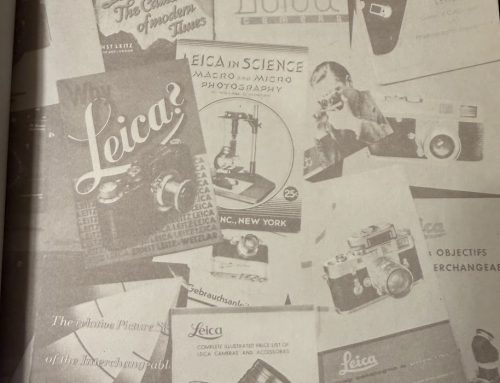
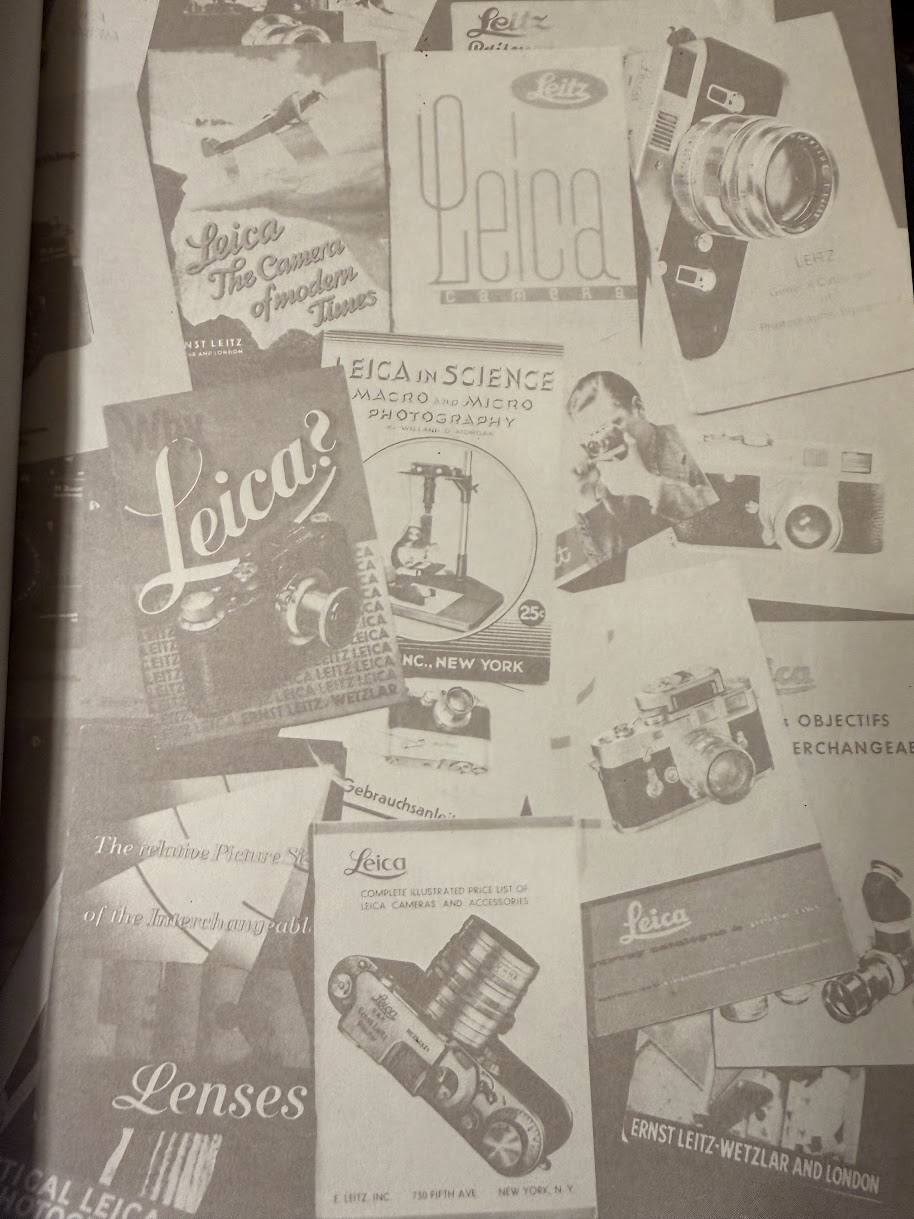
I recently read Leica Literature 1930–1960, written and compiled by prominent camera historian James L. Lager. Lager presents a lot of interesting information, but these were the highlights that were interesting to me:
The Leica opened up entirely new fields of photography, Neither telephote sports photography nor action photography with the hand held camera had been heard of until the arrival of the Leica. Photo reportage is probably the most important area in which the Leica has been used and the one to which it owes most of its acclaim. The Leica is certainly regarded as an exceptional tool by reporters all over the world. It was the spirit at the Wetzlar factory a spirit of co-operation, of cross-fertilization and of the blending of ideal concept, practical demands and technical realization-which provided the vehicle for the development of the Leica system. It was this spirit, fostered by Ernst Leitz I, that enabled Oscar Barnack to develop what began as his personal hobby into a great technical achievement.
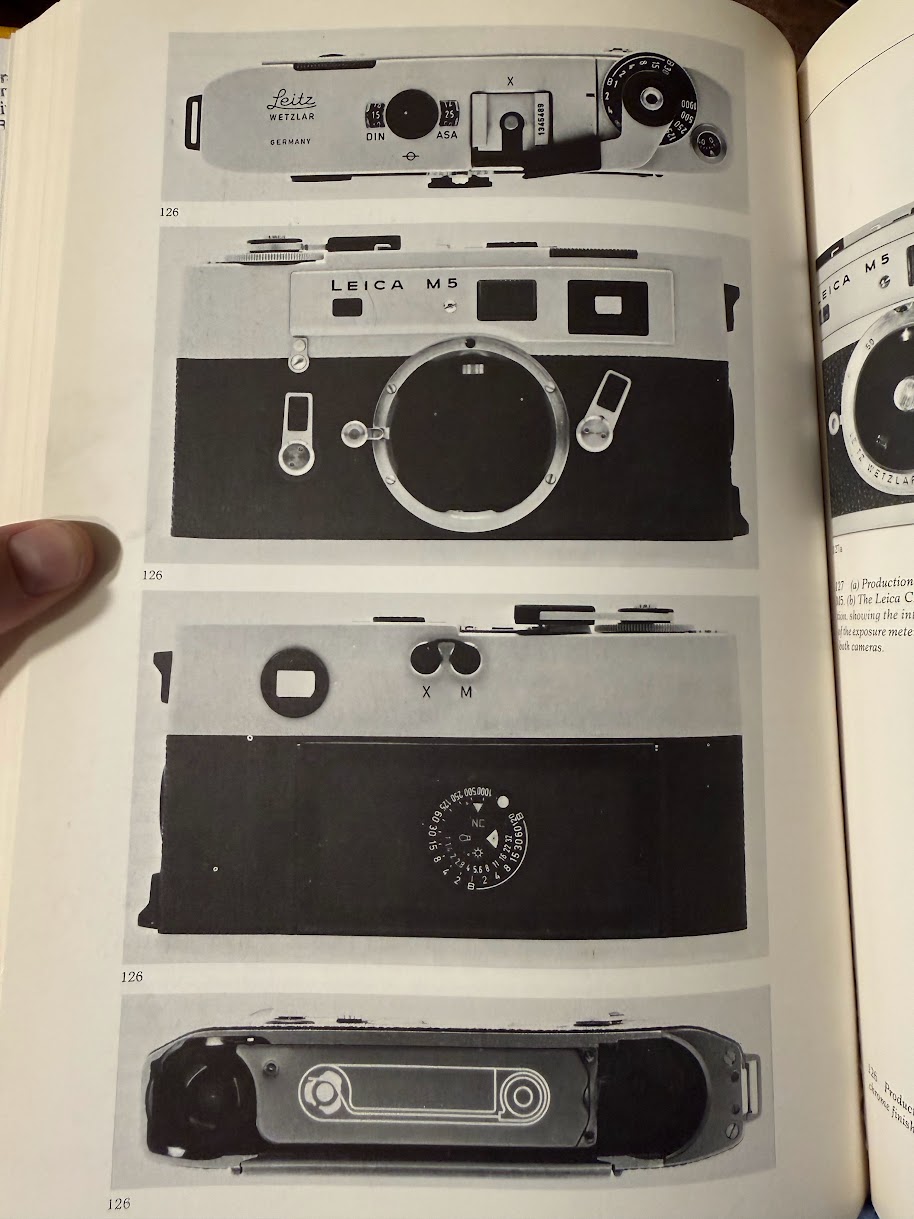
Before the Second World War Leitz were the undisputed leaders in every field of 35mm photography. Although the Leica was not the first 35mm camera, it was the first 35mm system camera-the first with a coupled rangefinder and interchangeable lens (if only by two months, the runner-up being the Contax) and the first with a stereo lens. Today, some critics allege that the Leitz company is lagging behind other firms that its designers no longer set new trends but copy others. But the Leitz designers, like all good designers, will only take up-and improve – someone else's idea if it is a good one. It is worth remarking briefly here on a few post-war Leitz achievements. The M5 led the way as the first CRF camera with through-the-lens metering. The R3 was the first auto-exposure SLR camera with spot and average metering systems. In the optical field, the 50mm f1.2 Noctilux was the first aspherical lens to be produced and the 50mm f1 Noctilux is still the only lens of that speed available. Although Zeiss-Ikon, with their Hasselblade and Contarexes, won most of the credit for the NASA moon expeditions launched by the United States, Leitz M2s were used on one of these (the Gemini expedition) and modified M4s (with Noctilux lenses) are still being used for similar purposes.
 interchangeable lens (if only by two months, the runner-up being the Contax) and the first with a stereo lens. Today, some critics allege that the Leitz company is lagging behind other firms that its designers no longer set new trends but copy others. But the Leitz designers, like all good designers, will only take up-and improve – someone else's idea if it is a good one. It is worth remarking briefly here on a few post-war Leitz achievements. The M5 led the way as the first CRF camera with through-the-lens metering. The R3 was the first auto-exposure SLR camera with spot and average metering systems. In the optical field, the 50mm f1.2 Noctilux was the first aspherical lens to be produced and the 50mm f1 Noctilux is still the only lens of that speed available. Although Zeiss-Ikon, with their Hasselblade and Contarexes, won most of the credit for the NASA moon expeditions launched by the United States, Leitz M2s were used on one of these (the Gemini expedition) and modified M4s (with Noctilux lenses) are still being used for similar purposes.
On the more ordinary plane, every small-format camera incorporates a Leica feature, if only the idea of the cassette, the number of exposures taken or even the folding rewinding crank. The Leica remains, beyond question, the finest 35mm camera ever produced.
The undoubted world-wide success of the Leica was due to too many factors for it to be possible to enumerate them all here. One which is easily explicable (the ease with which the camera can be handled) has already been mentioned. Of the purely technical features, probably the most significant was the shutter and the smoothness and reliability with which it operated – the outcome of painstaking development and remarkable engineering expertise. There are other points which are worth noting. The Leica shutter couples film advance and shutter tensioning, which avoids the common fault of double exposure. The interchangeable lens mount and the coupled rangefinder also appeal to photographers. In fact, its wide range of accessory lenses and other items put the Leica in a class of its own until the introduction of the Contax. All items were made to a high degree of mechanical precision. Barnack had become known among the factory workers as the man who could feel a hundredth of an mm, and no camera or component was allowed to leave Wetzlar before it had been rigorously tested. Indeed, the greater part of the production cost of the Leica went into the testing, not into con-struction. Only the very best materials were used and the extreme precision of workmanship characteristic of the manufacture of scientific instruments was applied to the assembly of the cameras. Workers underwent a long apprenticeship before being allowed to work on the assembly line.
The Leica is one of the finest cameras ever to have been produced – per-haps, indeed, it is the finest of all cameras. When owners of other makes of camera meet, they discuss photography; when people who are for-tunate enough to own Leicas meet, they discuss Leicas. Such is the prestige of the Leica that one might say that in nearly every photographic enthusiast who does not possess a Leica there is a Leica-lover struggling to escape.
Not surprisingly, a dedicated, closely knit fraternity of Leica specialists has grown over the years, each member having his own special passion within the Leica world. The owner of a 1925 fixed-lens model will not hesitate to discuss it on equal terms with the owner of the very latest model. Some purist collectors look down on any model (such as a Portugal or a Canadian) that is not a Leitz Wetzlar product. Others collect only rangefinder-coupled Leicas and ignore the later single-lens reflex models.
Not surprisingly, a dedicated, closely knit fraternity of Leica specialists has grown over the years, each member having his own special passion within the Leica world. The owner of a 1925 fixed-lens model will not hesitate to discuss it on equal terms with the owner of the very latest model. Some purist collectors look down on any model (such as a Portugal or a Canadian) that is not a Leitz Wetzlar product. Others collect only rangefinder-coupled Leicas and ignore the later single-lens reflex models.
The Leica enthusiast proceeds through several stages as he develops his knowledge and his collection.