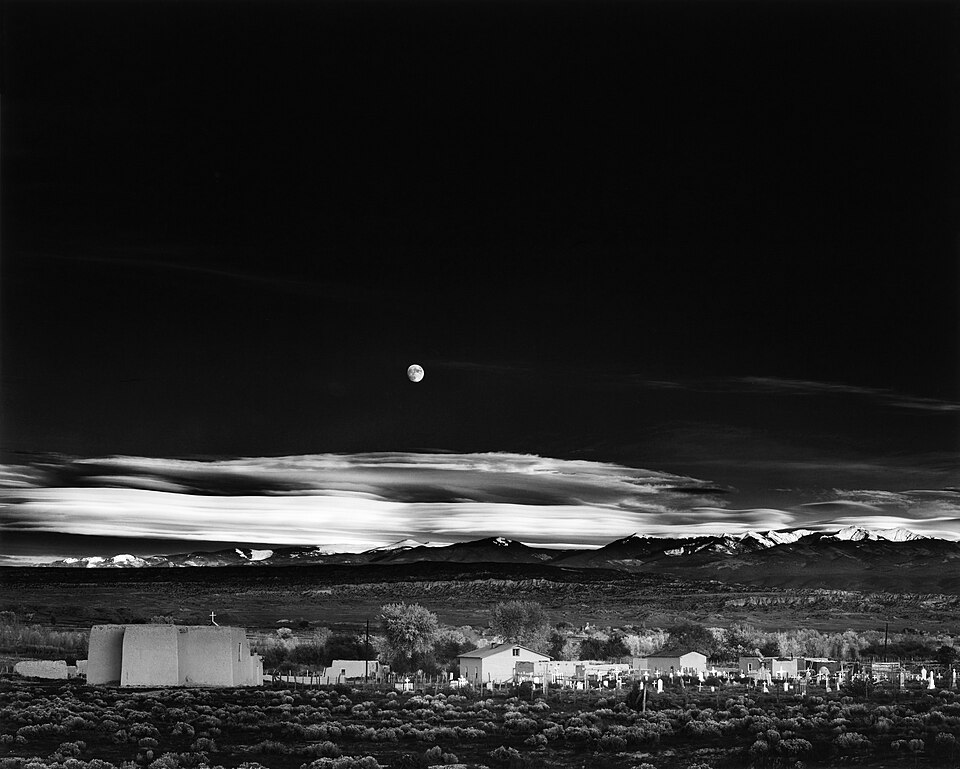
Driving back to Santa Fe after a disappointing day shooting, Ansel Adams stopped the car, grabbed his gear, and captured in 1941 near Hernandez, New Mexico, as the moon rose over the village. It’s one of Adams’s most famous images, requiring complex darkroom dodging and burning, adjusting the exposure in the enlarger, so that no two prints are completely identical. Adams was a magician in the dark room.
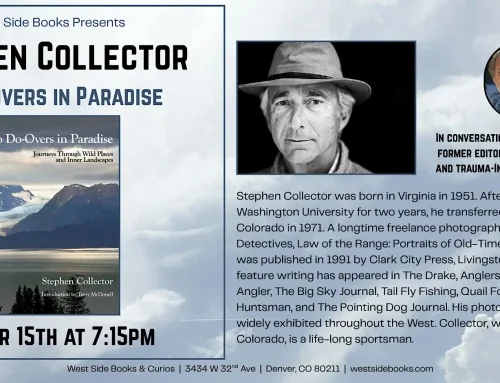
Stephen Collector has written and spoken about trying to photograph Hernandez, New Mexico, in his new book, No Do Overs in Paradise Valley, reflecting on how the landscape has changed since Ansel Adams captured his iconic masterpiece, “Moonrise, Hernandez, New Mexico”.
As a professional Colorado-based film and digital landscape photographer known for his magazine work, Collector decided to try to photograph a client’s ranch in the same fashion as Ansel Adams’s famous shot. Collector often contemplates the artistic legacy, technical parameters, and emotional weight left behind by Adams. In his essays, blog posts, and audio appearances (such as interviews featured in The Colorado Sun and related podcasts), Collector discusses his journeys through the American West and the reality of revisiting legendary photographic locations.
Collector notes that if you visit Hernandez today, you should not expect to find a bustling town or a neatly preserved monument marking where Adams stood. Hernandez remains a modest settlement, and the view has dramatically changed from the pristine look of 1941. Collector emphasizes that Adams’ image was born out of profound instinct and rapid calculations when he couldn’t find his light meter. Replicating the shot is impossible because a large part of what makes “Moonrise” compelling is the extensive darkroom work—dodging, burning, and manipulating contrast—that evolved decades later. For film photographers like Collector, trying to extract a photograph from that same land comes with deep questions about what art serves. He highlights that unlike many of Adams’s grand, human-free nature photographs, “Moonrise” resonates deeply because it displays the “footprint of mankind”—crosses, dwellings, and a modest community working together to tame an unforgiving, vast natural world.
Collector doesn’t publish the photograph that he spent nights in a tree stand trying to recreate, so I assume it didn’t work out. But the lesson of the story is that I never really looked at Adams’s work in that light, it seemed old fashioned and dated. Now, I am studying his images in a new light, literally and figuratively, as they do have a unique magic to them.
https://www.anseladams.com/collections/explore-icons