
I have fished with Rim Chung more weekends than not for the past twenty years and I a self-confessed student of his method, so you may find this article a bit biased towards his method. For this method has been my only one for nearly that entire span of time, feeling it is the most effective manner of catching trout, salmon and grayling in streams. 
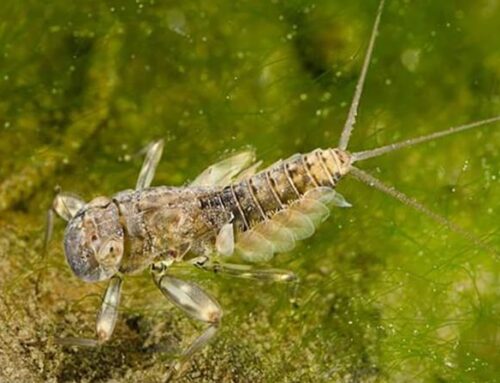
Knowing that Rim has only fished one fly in about six sizes and six colors for the past thirty years, I asked him a question a couple of years ago, “If you only had one RS2s to choose from which would you choose?”
He shot back, “The question should become on which river? If it were for use on a freestone river, I would choose size 16. Any color would do the job. But for a tailwater, such as the Deckers area of the South Platte, you would have to have various sizes and colors.”
Rim continued, “From nearly thirty years of fishing that river, you see, I have assembled a so-called hatch chart in my own mind. From that length of experience, I can reasonably predict the predominantly available insect life for a particular time of year. In the winter, my favorite for that river would be size 24 black. I am sure that I can get by with that particular size and color all winter long, because of the predomination of small midges that time of season for that particular river.”
I continued to push for a hint of limitations or at least where to start among the thirty six RS2s in his box, “Could you use that same fly for a season, such as the summer, maybe a small black one to represent the predominant Tricos?”
Rim responded, “Well, for Tricos as you know, the spinners are actually a different color at the time of hatching then they are during the spinner fall. So the sub-question there would become at what time of the hatch are you fishing? For a Trico hatch, I would prefer a size 20 in a dirty dun gray color. Whereas if you were fishing the spinner-fall, then unquestionably, I would have a black fly of the same size.”
“Where would you start in the spring on a tailwater?”
Rim said, “In the spring if I could only use one fly on that river, I would choose a gray or olive bi-color in size 20.”
Knowing the answer to the next question but asking for the reader’s benefit I asked, “Why don’t you ever fish a dry fly?”
Rim said authoritatively, “I do not have any objection to dry flies. But why would I fish dry flies? I catch fish with RS2s. Why do I have to switch flies? A lot of guys go out there and put on a dry fly just to make a beautiful cast. Most dry fisherman are certainly aware that nymph fishing is much more productive. Some dry fly anglers concede that they are incapable of learning the finer technique of nymph fishing. I find the nymph to be more effective, as it is the difference between asking your spouse where she would like breakfast and then serving her in bed, instead of ringing a bell and trying to get her to come down to the table.”
I asked about lines and rods, knowing that Rim is an advocate for light lines and fine action rods. He replied, “Before we discuss that, we must discuss the premise of liking or disliking certain things. That is, fly line was designed to cast the fly. The finer lines accomplish that purpose. Why do you have to consider something else?” This is an example of Rim’s Buddhist paradigms, leaving the student to reach his own conclusion as to why not.
He continued, “In the older days, when I started fishing, things were made much more incondite. We used thick bamboo rods with gut leaders. Fine silk leaders were something to be highly prized because of their fine qualities, but not readily available in the finest sizes we have now. Along with it, the relatively fewer anglers we had on the streams in those days were able to get by and catch enough fish with size 10 or 12, very large, flies. Whereby, they were able to get by with this heavy crude equipment and flies. Even with the sub-stages of refinement in the impertinent technological youthful stage of the sport a few decades back, fly fishing rods became much more readily palpable in the hands of a novice, compared to what the original fly fishers had available. The bamboo rods were heavy enough to give a positive feeling of the loading and unloading of the also heavy fly line. They were able to use that equipment not only reasonably, but rather it became a category of choice, especially for the novice. But the present day fishing has changed drastically from that condition. We have available much lighter tippets, much lighter rods, and the flies are much smaller, as the trout have also become more pressured on most if not all waters. With those refinements, which prove to be more effective, I see no reason to go back to the obsolete stage of the game. The light lines and rods which I use now do at least as good of a job, if not distinctively better. Why would we stick with the traditional 5 weight just for the sake of tradition?”