Turquoise is the People’s Gemstone
While popular culture often paints the Wild West in dusty shades of brown and gray, turquoise provided its defining splash of color. Each person is drawn to a particular piece of turquoise for their own reasons, be it color, story, history, or use and that creates the subjective beauty of it. Its significance wasn’t just aesthetic; it sat at the exact intersection of ancient Indigenous spirituality, a rapidly changing frontier economy, and the birth of American Southwest mythology, long before it was a beloved accessory among free-spirited fashionistas. It’s a rare, natural stone and it’s connected to the land, the outdoors, and the wild. It offers protection, water, life, healing, good fortune and a connection to the creator.
The Sacred Root: Indigenous Connection
Long before Spanish explorers or American pioneers headed west, turquoise was deeply sacred to the Native nations of the Southwest—particularly the Navajo (Diné), Zuni, Hopi, and Pueblo peoples.
For these cultures, turquoise was not a commercial gemstone; it was a living piece of the sky and a symbol of water, creation, health, and protection.
-
-
The Navajo associated it with the Changing Woman (a principal deity) and believed wearing it offered protection from evil and ensured good health.
-
The Zuni prized it as a ceremonial stone, often carving it into intricate fetishes (small animal carvings) to channel spiritual power and safe passage.
-
The Apache believed that attaching turquoise to a bow or firearm guaranteed dead-eye accuracy.
-
The Frontier Cross-Cultural Boom (Late 1800s)
The “Wild West” era saw a dramatic shift in how turquoise was used, driven by cultural exchange—and economic necessity—between Native artisans and Euro-American settlers.
Around the 1860s and 1870s, a Mexican blacksmith taught Navajo ironsmiths how to work silver. Soon after, Navajo artisans began embedding local turquoise into hand-hammered silver coins and ingots. This created an entirely new aesthetic that we recognize today as classic Southwestern jewelry.
As the transcontinental railroads pushed west in the 1880s, an influx of tourists, traders, and homesteaders arrived. Anglo traders like Lorenzo Hubbell established trading posts across the region, realizing that eastern travelers were captivated by this vibrant blue jewelry. It quickly became the ultimate frontier currency, traded for groceries, fabric, and supplies.
The Great Turquoise Rush
As demand exploded, the hunt for the stone triggered a mining boom that rivaled the search for gold and silver, although it is technically a hydrated phosphate of copper and aluminum formed by percolation of rain or ground water through aluminum and copper rich rock in arid environments. It is found from Iran to China, Egypt to Mexico and the American Southwest.
Prospectors quickly realized the Southwest was one of the richest turquoise deposits on earth. Towns sprang up around massive deposits:
-
The Cerrillos Mines (New Mexico): One of the oldest mining sites in North America, heavily mined by the Indigenous people for centuries, it was claimed by American miners in the late 1800s.
-
Kingman & Bisbee (Arizona): Copper mining towns discovered that turquoise was a natural byproduct of copper weathering. The brilliant blue stones found in these deposits became world-famous.
Even luxury eastern institutions wanted a piece of the Wild West. In the late 19th century, Tiffany & Co. bought up mining claims in New Mexico to secure a supply of “Cerrillos blue” turquoise for their high-end jewelry collections in New York, cementing the frontier stone as a national luxury.
The Visual Signature of the West: Ultimately, turquoise became the literal color palette of the American frontier. It represented a rare moment where Indigenous tradition, geological fortune, and pioneer trade blended together to create an enduring symbol of American identity.
Sleeping Beauty Turquoise
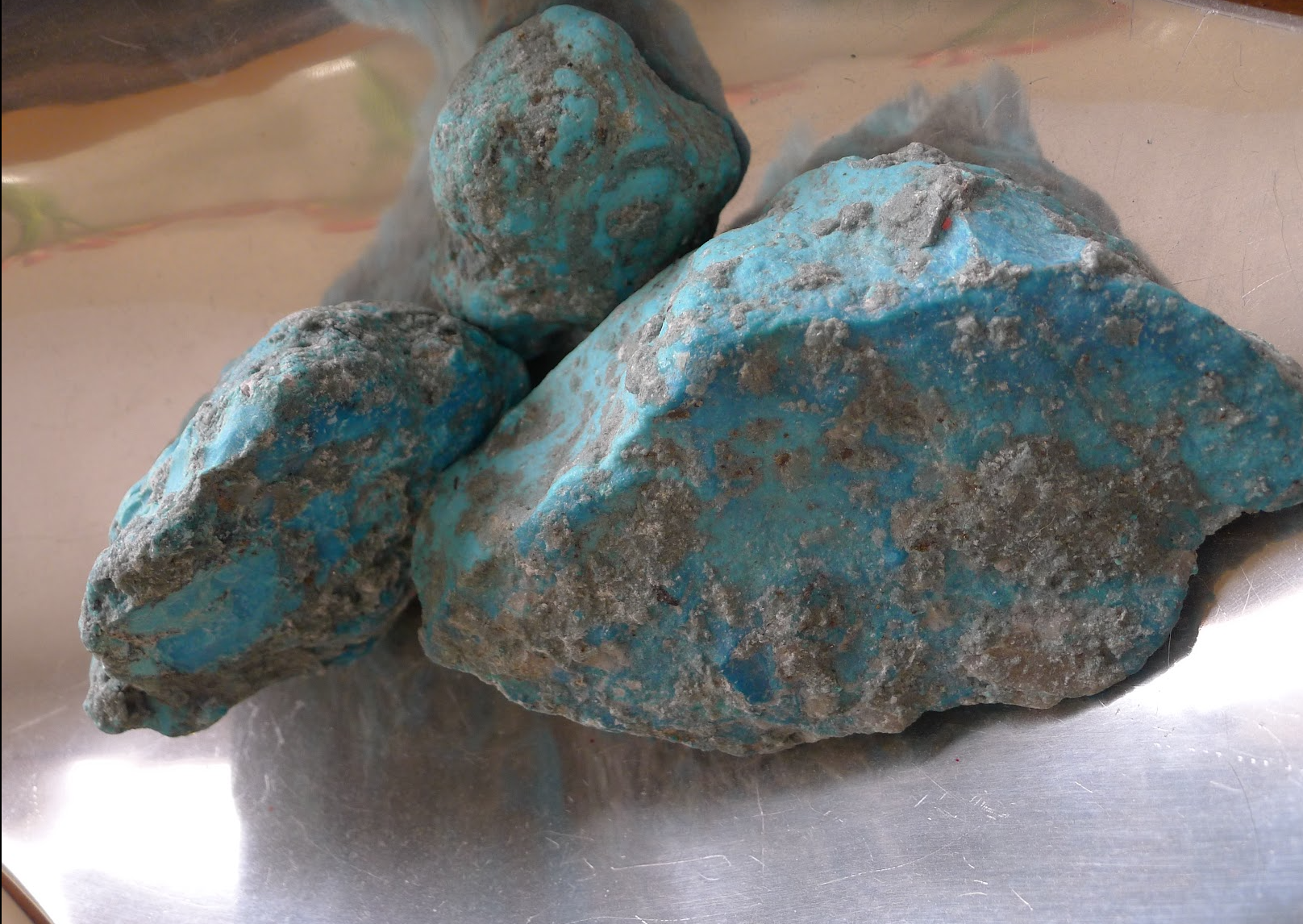
Sleeping Beauty turquoise is one of the most recognizable varieties in the world, often synonymous with the term “turquoise.” Its vibrant sky-blue hue and minimal matrix have contributed to its global fame, rivaling even the highly sought-after robin’s egg blue Persian turquoise. This gemstone typically forms in nuggets featuring a soft white matrix, occasionally containing small amounts of quartz or pyrite. Over time, as demand shifted towards stones with more matrix, some sellers began artificially darkening the matrix using shoe polish and other methods to enhance contrast.
Located in Globe, Arizona, the Sleeping Beauty turquoise mine is renowned as a major producer of turquoise, yielding everything from low-grade white chalk to high-quality, sky-blue stones prized in European markets that favor a matrix-free appearance. Its consistent color, affordability, and high availability have made it a favorite among Native American artisans, particularly from the Zuni Pueblo.
The mine gets its name from the nearby mountain range, which is said to resemble a sleeping woman with crossed arms when viewed from a distance.
Due to rising government regulations and mining costs, the mine closed in 2012, leading to a significant increase in the price of Sleeping Beauty turquoise since then.
_______________________________________________________________________________________________________
IMITATION TURQUOISE
Some material sold as turquoise is actually colored plastic. In other cases, real minerals such as howlite and quartzite are dyed to imitate natural turquoise and can be difficult to identify as fakes.
Other stones simply resemble the real thing. Several of these so-called “turquoise family” minerals share similar chemical formulas, form in rocks in similar ways, and have similar crystal structures. Because turquoise is more marketable, these stones are sometimes sold as turquoise, which is unfortunate because they are attractive in their own right:
- Chalcosiderite (kal-koh-SID-er-ite) is a whitish mineral also known as New Lander.
- Chrysocolla (kri-SOH-koh-lah) is a hard green-blue mineral whose colors often vary widely within the same specimen.
- Faustite (FAWS-tite) is an apple-green mineral that forms alongside turquoise in Nevada’s Carico Lake region and other locations.
- Variscite (VEH-rih-site) ranges from light to dark green and often displays attractive webbing patterns.
- Malachite (MAL-uh-kite) and Azurite (AZH-er-ite) are copper ores that, like turquoise, are cut and polished for jewelry. Their blue and green colors — and even the regions where they are found — closely resemble those of turquoise.
Get It in Writing
How can you protect yourself from misrepresentation? The best way is to obtain proper written documentation of your purchase. Turquoise dealers are legally required to accurately and truthfully represent the stones they sell and to fully disclose any treatments or enhancements.