

What if you only had 10,000 days left?
The Average Person Lives 27,375 Days. Make Each of Them Count.
That is the average lifespan in the United States today: 27,375 days. If you are typical, that is what was deposited in your “time bank” when you were born. Every day, whether or not you want to, you make a withdrawal of 1 day. When the days run out, you die. Game over.
To find out how much time you have left if you are an average man or woman, take your age and multiply it by 365. Then, subtract it from 27,375 days. For example, if you are 25 years old, you have 18,250 days to live (27,375 days – 9,125 (because 365 x 25 = 9,125)). If you are 50 and average, you have 9,125 days left to live. If you are 65, you have 3,650 days left to live.
The average person lives 27,375 days. Make each one count. Spend part of the year fishing in Canada or sailing in the Caribbean. Learn to cook or paint. Don’t just sit in your office or at home, mindlessly collecting pieces of paper called money so you can pay for a car that needs to be replaced every few years or a house that won’t do you any good when you are gone!
One of the secrets to Steve Job’s success was reminding himself every day that he was going to die. Only a few years later, he did just that. He had fewer days than most people, passing away at 56 years old, yet accomplished more than almost anyone who has ever lived. “It’s easier to sort out problems on top of a horse,” Ronald Reagan.
You will die. Make sure your life means something. Calculate how many days are left in your “typical” mortality bank and do your absolute best to make every one of them count. Look around you. If you don’t like how you are spending today, change it. Don’t spend your life stuck somewhere you don’t love, doing something about which you aren’t passionate about, surrounded by people you can barely tolerate. This isn’t a dress rehearsal, as the old saying goes. Make it count.
Adapted from https://www.joshuakennon.com/the-average-person-lives-27375-days-make-each-of-them-count/
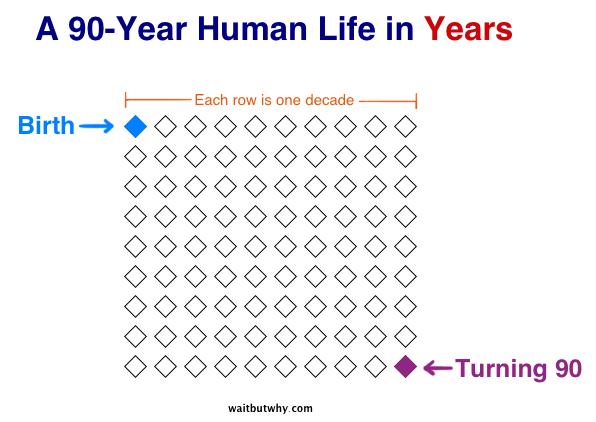
Your Life in Weeks
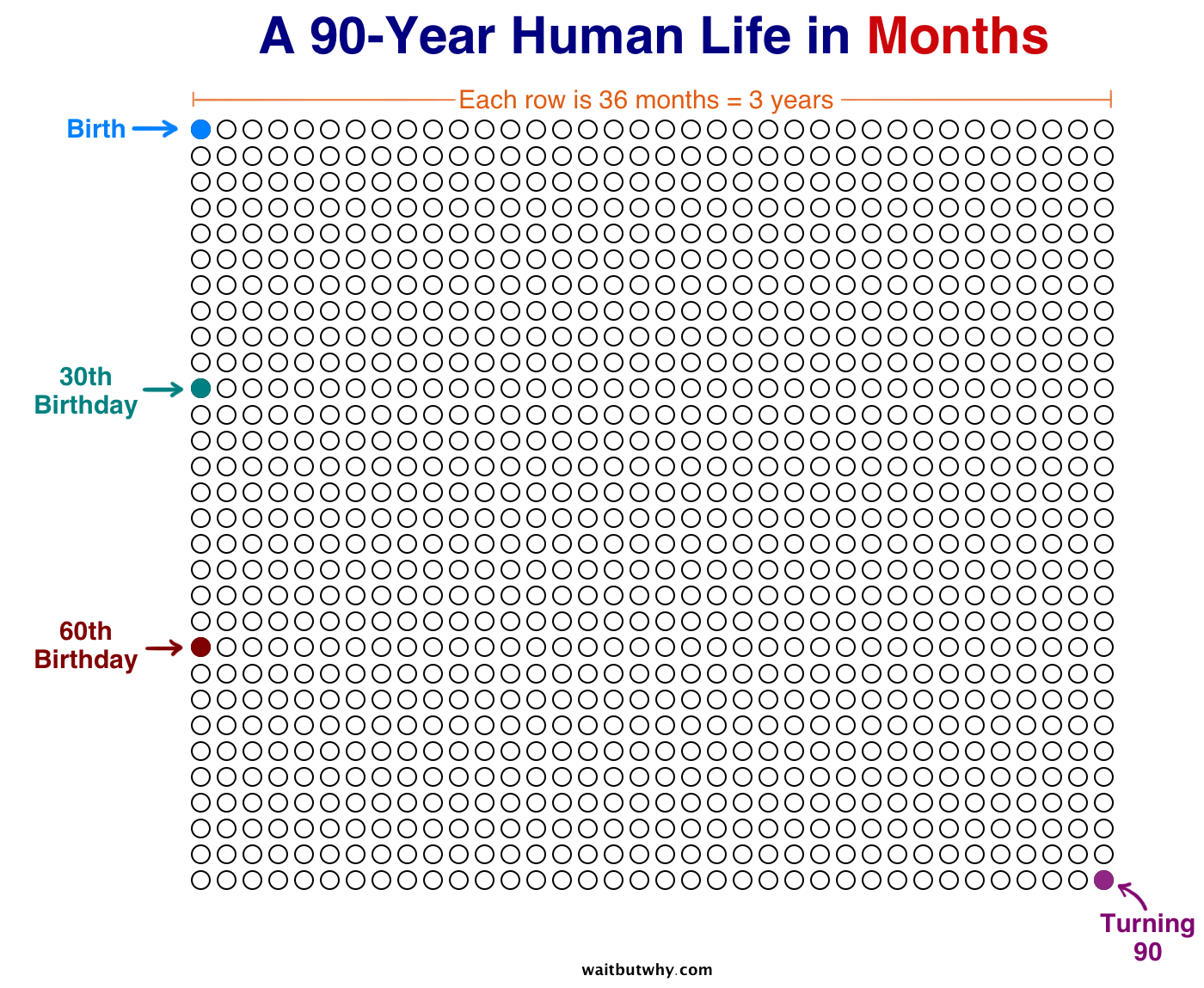
And here’s a human life in months:
But today, we’re going to look at a human life in weeks:
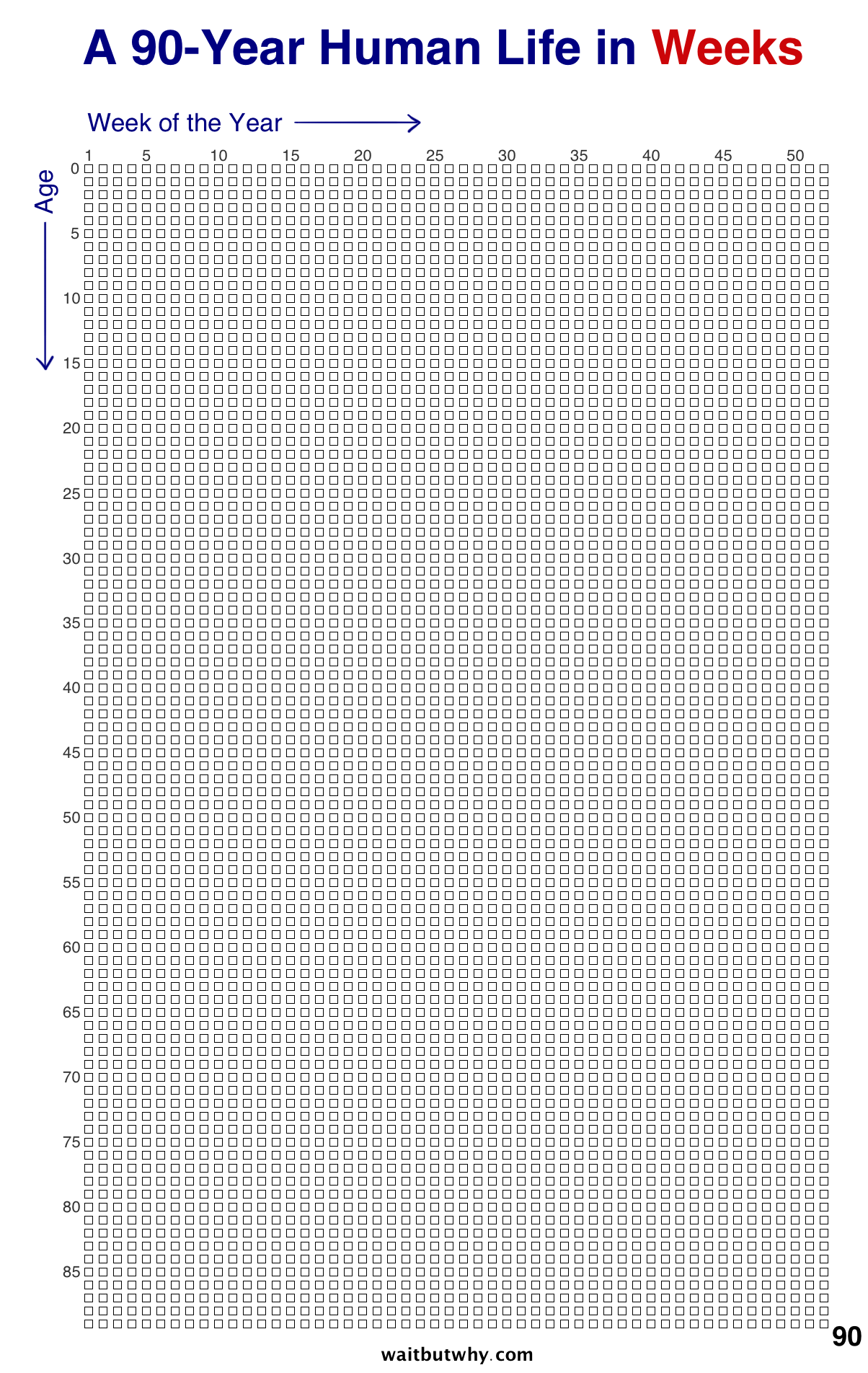
Each row of weeks makes up one year. That’s how many weeks it takes to turn a newborn into a 90-year-old.
It kind of feels like our lives are made up of a countless number of weeks. But there they are—fully countable—staring you in the face.
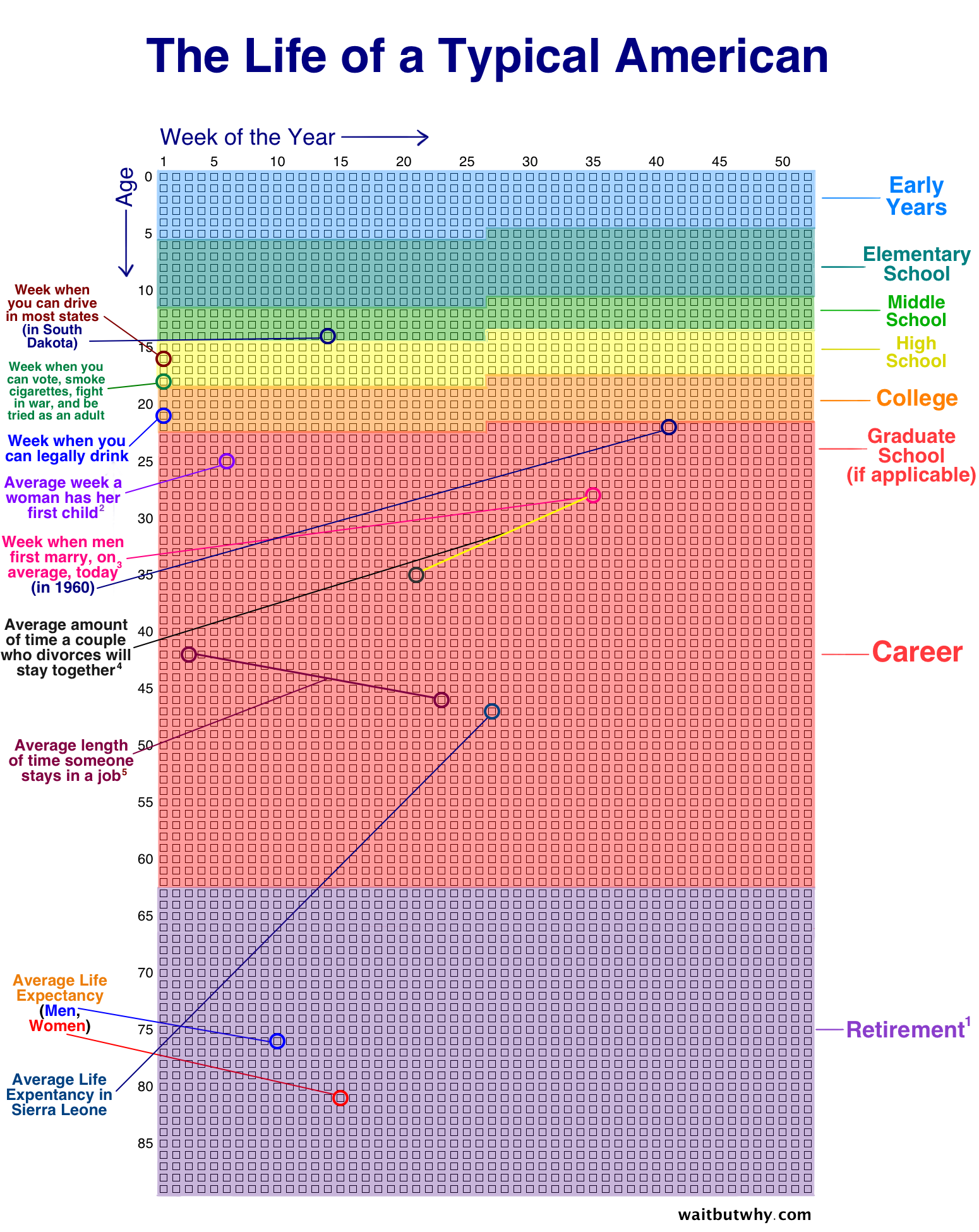
Before we discuss things further, let’s look at how a typical American spends their weeks:
Sources:
http://www.gallup.com/poll/168707/average-retirement-age-rises.aspx
“>1
http://www.babycenter.com/0_surprising-facts-about-birth-in-the-united-states_1372273.bc
“>2
http://www.pewsocialtrends.org/2011/12/14/barely-half-of-u-s-adults-are-married-a-record-low/
“>3
http://www.census.gov/prod/2011pubs/p70-125.pdf
“>4
“>5
There are some other interesting ways to use the weeks chart:
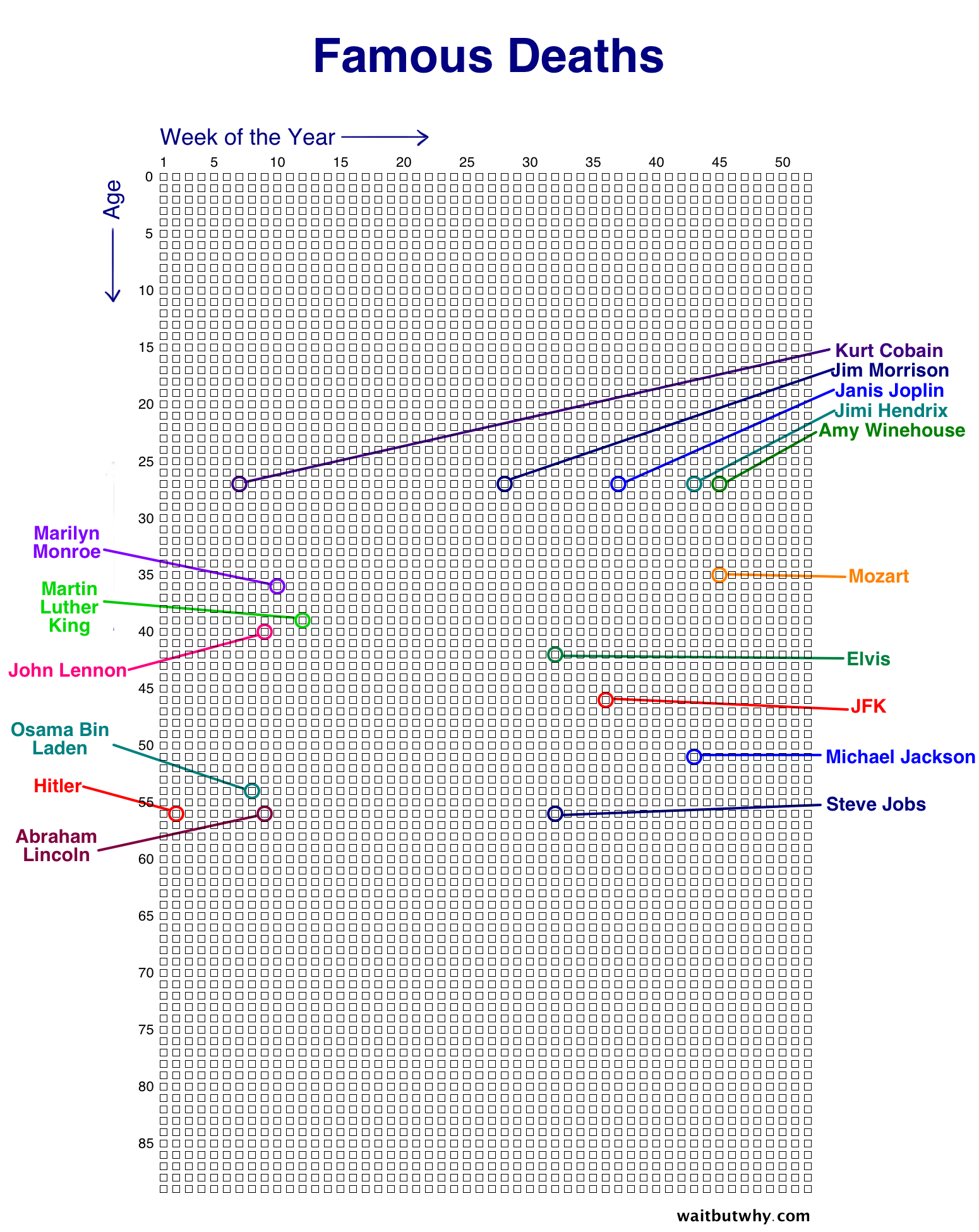
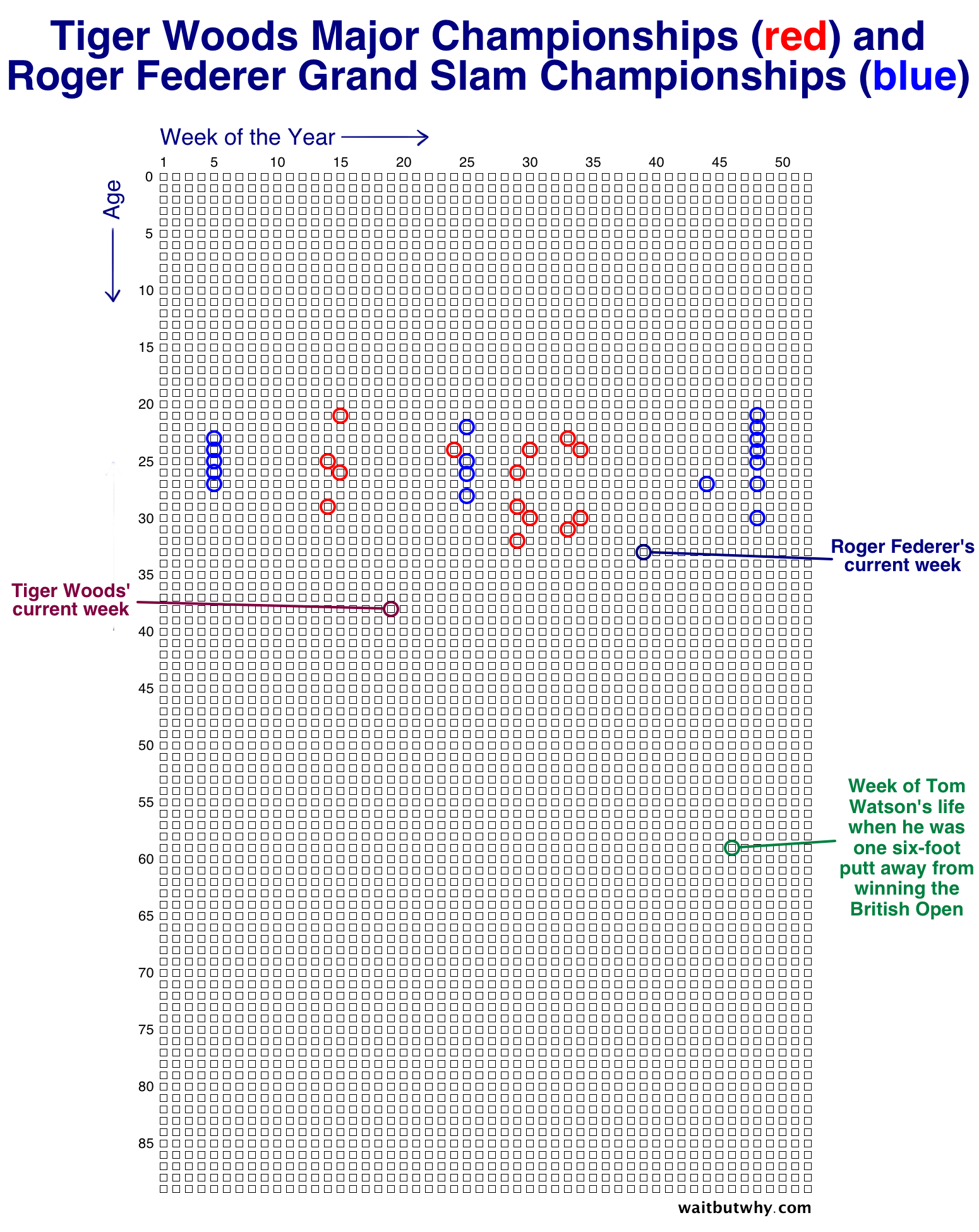
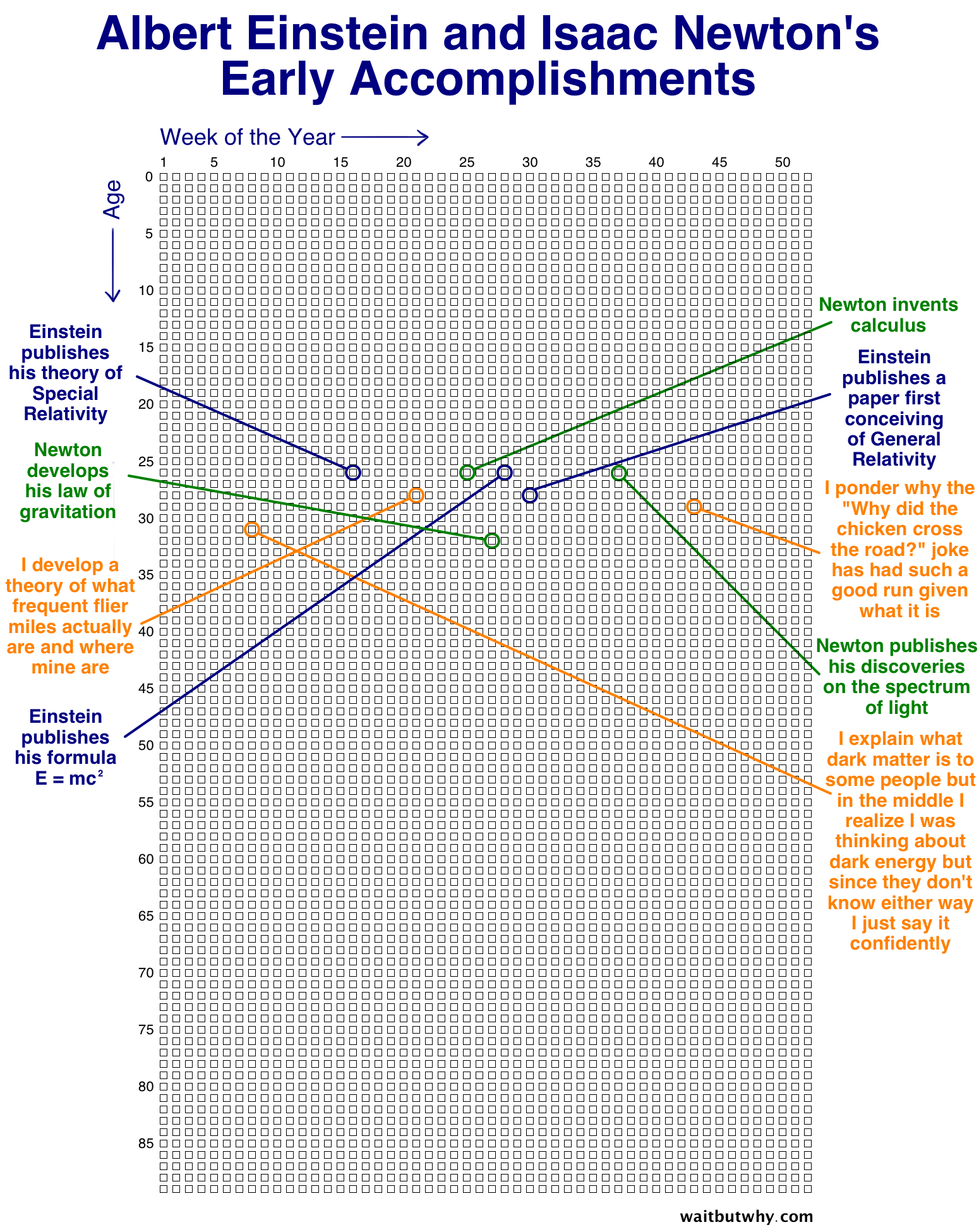
But how about your weeks?
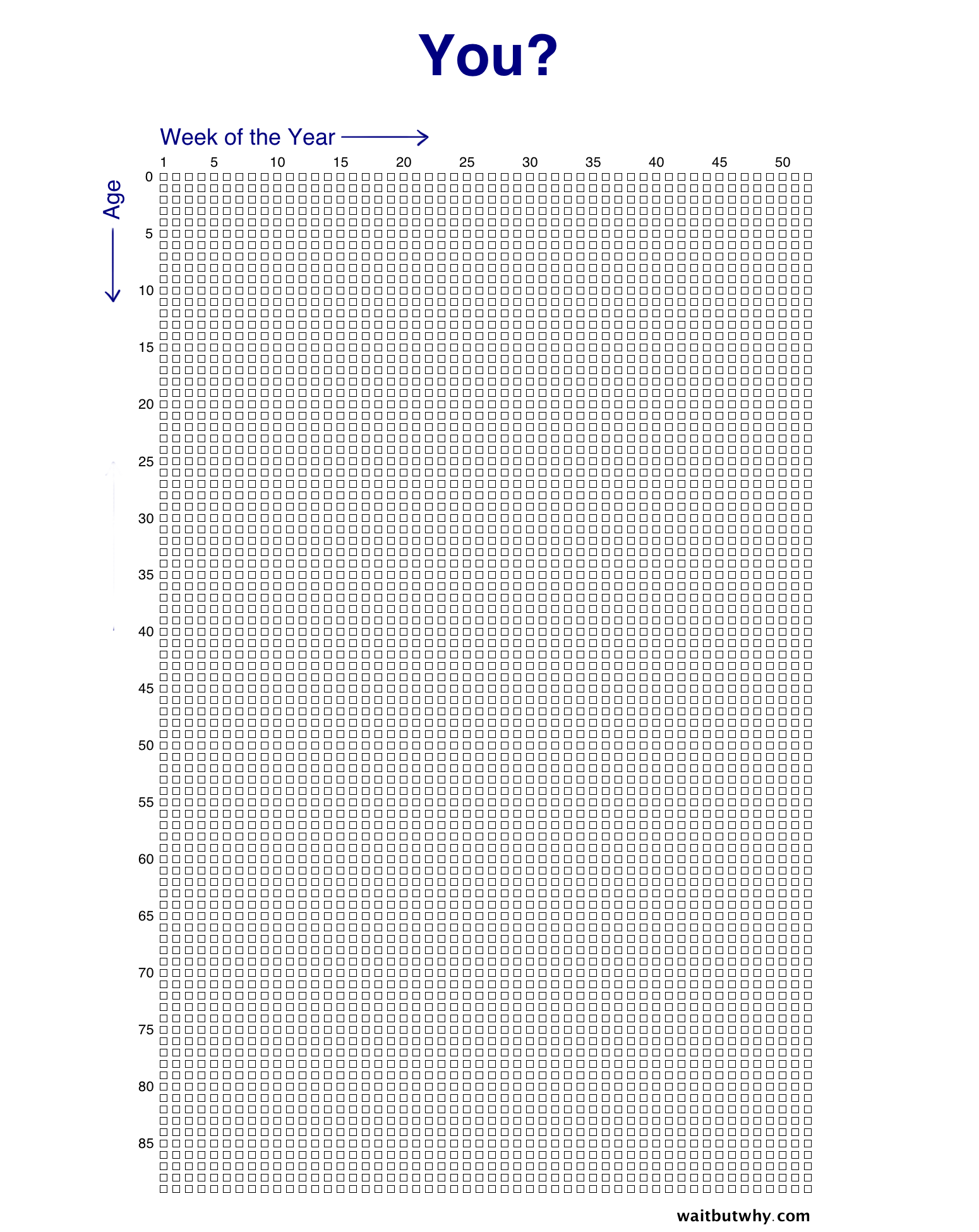
Sometimes life seems really short, and other times it seems impossibly long. But this chart helps to emphasize that it’s most certainly finite. Those are your weeks and they’re all you’ve got.
Given that fact, the only appropriate word to describe your weeks is precious. There are trillions upon trillions of weeks in eternity, and those are your tiny handful. Going with the “precious” theme, let’s imagine that each of your weeks is a small gem, like a 2mm, .05 carat diamond. Here’s one:
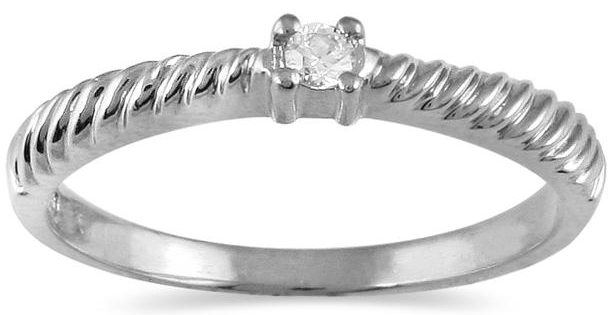
If you multiply the volume of a .05 carat diamond by the number of weeks in 90 years (4,680), it adds up to just under a tablespoon.

Looking at this spoon of diamonds, there’s one very clear question to ask: “Are you making the most of your weeks?”
In thinking about my own weeks and how I tend to use them, I decided that there are two good ways to use a diamond:
1) Enjoying the diamond
2) Building something to make your future diamonds or the diamonds of others more enjoyable
In other words, you have this small spoonful of diamonds and you really want to create a life in which they’re making you happy. And if a diamond is not making you happy, it should only be because you’re using it to make other diamonds go down better—either your own in the future or those of others. In the ideal situation, you’re well balanced between #1 and #2 and you’re often able to accomplish both simultaneously (like those times when you love your job).
Of course, if a diamond is enjoyable but by enjoying it you’re screwing your future diamonds (an Instant Gratification Monkey specialty), that’s not so good. Likewise, if you’re using diamond after diamond to build something for your future, but it’s not making you happy and seems like a long-term thing with no end in sight, that’s not great either.
But the worst possible way to use a diamond is by accomplishing neither #1 nor #2 above. Sometimes “neither” happens when you’re in either the wrong career or the wrong relationship, and it’s often a symptom of either a shortage of courage, self-discipline, or creativity. Sometimes “neither” happens because of a debilitating problem.
We’ve all had Neither Weeks and they don’t feel good. And when a long string of Neither Weeks happens, you become depressed, frustrated, hopeless, and a bunch of other upsetting adjectives. It’s inevitable to have Neither Weeks, and sometimes they’re important—it’s often a really bad Neither Week that leads you to a life-changing epiphany—but trying to minimize your Neither Weeks is a worthy goal.
It can all be summed up like this:

The Life Calendar
One of the ways we end up in NeitherLand is by not thinking about things hard enough—so one of the most critical skills is continual reflection and self-awareness. Otherwise, you can fall into an unconscious rut and waste a bunch of precious diamonds.
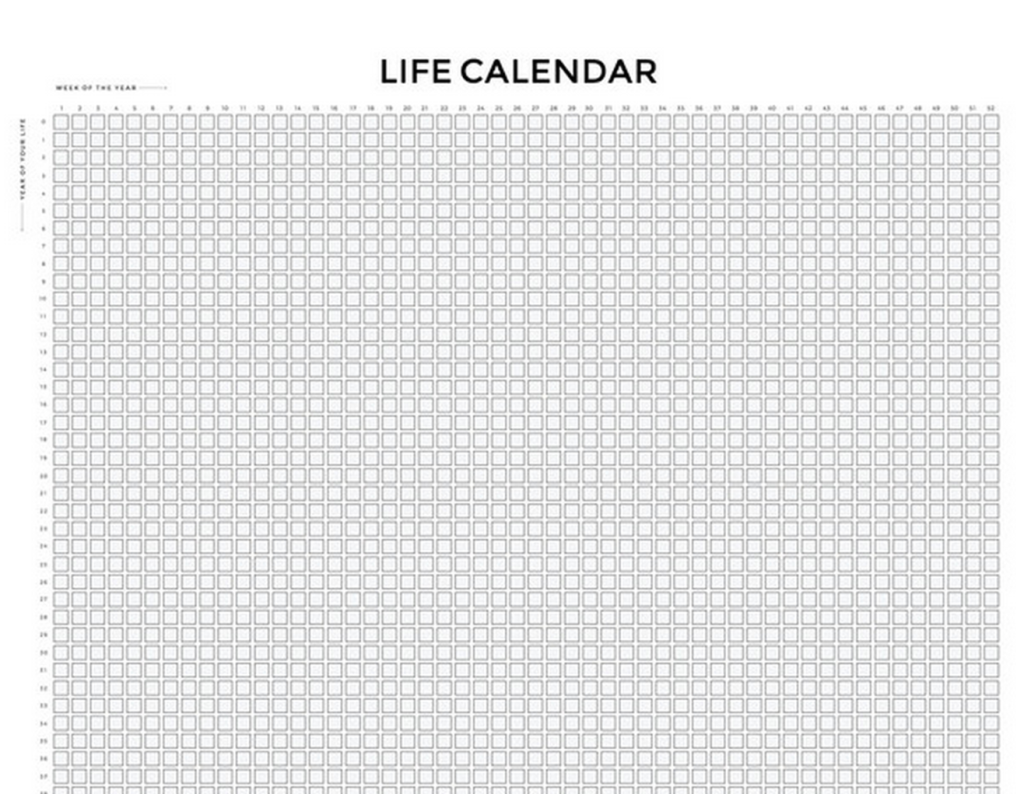
To help both you and ourselves stay conscious and avoid NeitherLand, we’ve created a Life Calendar that lays out every week of your life on one sheet of paper. We don’t typically bring products into posts, but in this case, they go hand-in-hand.
The calendar is a 24″ by 36″ poster on high-quality poster paper, made to be written on and last for decades. It costs $20 and you can buy it here.
Besides the purpose of encouraging regular reflection, we hope the calendar can help you feel more oriented in your life, help you set goals and hold yourself to them, and remind you to be proud of yourself for what you’ve accomplished and grateful for the diamonds in your spoon.
How you use the calendar is totally open for creativity. Some possibilities:
- Highlight the weeks in the past in different colors to segment them into “life chapters”—i.e. High School, College, Job 1, Job 2, New City, Engagement, Marriage, etc., or maybe a whole other conception of what a life chapter means to you. You can also mark special boxes where key turning points happened.
- Write something in each week’s box as it goes by—the boxes are large enough to write a few words in with a sharp pencil.
- Plot out goals for the future by making a mark on a future box and visually seeing exactly how many weeks you have to get there.
- If you’re a new parent, it might be fun to make one for your child so they can look at it later and have some info on what happened in the first few years of their life.
- Or maybe you’d rather leave it totally untouched.
Both the week chart above and the life calendar are a reminder to me that this grid of empty boxes staring me in the face is mine. We tend to feel locked into whatever life we’re living, but this pallet of empty boxes can be absolutely whatever we want it to be. Everyone you know, everyone you admire, every hero in history—they did it all with that same grid of empty boxes.
The boxes can also be a reminder that life is forgiving. No matter what happens each week, you get a new fresh box to work with the next week. It makes me want to skip the New Year’s Resolutions—they never work anyway—and focus on making New Week’s Resolutions every Sunday night. Each blank box is an opportunity to crush the week—a good thing to remember.
______
During a study at Harvard in the 1950s, Dr. Curt Richter placed rats in a
pool of water to test how long they could tread water.
On average they’d give up and sink after 15 minutes.
But right before they gave up due to exhaustion, the researchers would
pluck them out, dry them off, let them rest for a few minutes – and put
them back in for a second round.
In this second try – how long do you think they lasted?
Remember – they had just swam until failure only a few short minutes ago …
How long do you think?
Another 15 minutes?
10 minutes?
5 minutes?
No!
60 hours!
That’s not an error.
That’s right! 60 hours of swimming.
The conclusion drawn was that since the rats BELIEVED that they would
eventually be rescued, they could push their bodies way past what they
previously thought impossible.
I will leave you with this thought:
If hope can cause exhausted rats to swim for that long, what could a belief
in yourself and your abilities, do for you?
Remember what you’re capable of. Remember why you’re here. ”
Keep swimming.