Sporting Road

About Sporting Road

This author has not yet filled in any details.
So far Sporting Road has created 486 blog entries.

At the Grave of the Unknown Fisherman

John Gierach, Simon & Schuster, NY 2003 This book is classic Gierach and good reading.  It features his BFF, Mike Clark, who is a self-taught bamboo rod maker, now living in Lyons, Colorado, near Gierach, who meets Walt Carpenter, who worked for two of the greats in bamboo, Leonard and Payne, and then built his own rods using the old F.E. Thomas Milling machine.  He mentions his favorite light bamboo rods: a 7’9” Legacy by John Bradford, a 7’9” by Mike Clark, and an old 7 ½-foot F.E. Thomas Special, circa 1940—all two-piece 5 weights, which is not what I would consider light, but he is a dyed in wool dry fly fisher with larger favorite flies than mine.  And there are stories about his other buddy, A.K. Best, who talks about his mentoring under Koke Winter.  And an old guy, who said to Gierach, “Boy, I’ve forgotten more about fishing than you’ll ever know.”  Or the retort that “Fly-fishing can be upscale and exotic if you want it to be and can afford that, but at base it’s homegrown, backyard stuff:  something people used to do when the chores were done; a way of goofing off that was barely justified by a couple of fresh fish for supper.” There is more than great characters and quotes, such as discussion of Muriel Foster’s Fishing Diary and videos on fly fishing which “seems a little like movie sex: fun to watch, but a long way from the real thing” wand which can amount to “information without proper instruction.”  I like the comment of the fly shop customer who asks how long to get really good at this and Gierach responds, “Ten years, if you fish three or four times

By |June 14th, 2011|Categories: Book Reviews, Fishing|Comments Off on At the Grave of the Unknown Fisherman

Ultraweight Rods Remain My Childhood Fantasies

My childhood fantasies still haunt me.  Nearly every day in the winter, we would walk down to the neighborhood pond and play hockey until we were called in for dinner or until darkness made it no longer able for us to play.  We do the same thing now with polo.  And, in the summer, we fished the same pond from dawn to dusk for bass.  And, I still do now with fly rods for trout, as much as possible with work and other hobbies, so sometimes I am left with fantasizing about them all.   In my childhood, my buddy and I fished, nearly exclusively, with the Diawa Minicast rod and reel.  And, now, I do the same with light weight fly rods, from 0-weight to 3-weight rods for trout.  Sure we had other fishing rods, and do now as well, but these were our favorites, and still are.  The fish felt bigger and we lost fewer of them.  The Diawa Minicast it advertised that, "you’ll always have a high-quality ultralight set-up that's ready to catch fish wherever you are... which matches an ultralight reel featuring an aluminum alloy body and nose cone, smooth disc drag and easy push button ... with compartments which fit inside your suitcase or under car seat." I guess I still haven’t grown up, as I still fancy ultralight rods and flies.  In 1982, Howard Steere designed the Orvis Superfine 2-weight, then the Orvis Superfine 1-weight, which truly transported fly fishing into the world of ultralight. Shortly thereafter, Jerry Siem moved from Winston to Sage evolved ultralight fishing by designing the first of three revolutionary families of truly unrivaled ultralight fly rods. First was the Sage TXL 0-weight.  This was followed in of 1997, with the whole family of Sage SPL ultralights, which were revolutionizing in featuring the latest newest materials

By |June 10th, 2011|Categories: Fishing|Comments Off on Ultraweight Rods Remain My Childhood Fantasies

Pocket and Pasture

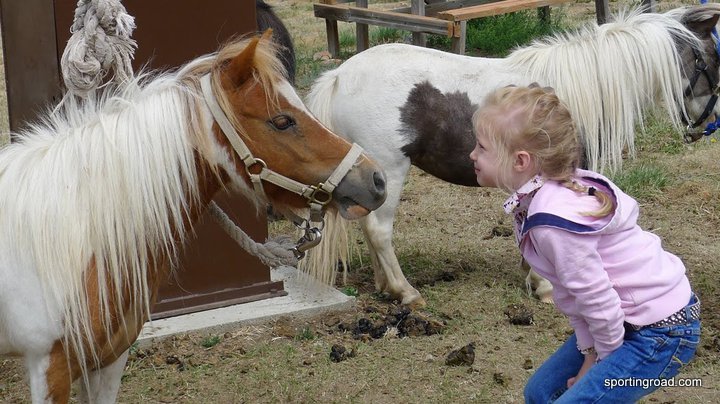
      Our foxhunters are out to pasture, while our polo ponies are now in work.  And our daughter's pony, Pocket, is fat and happy in his green pasture, despite being asked to take a little work this summer.    Shoot Low, Boys, They're Ridin' Shetland Ponies!  

By |June 7th, 2011|Categories: Foxhunting|Comments Off on Pocket and Pasture

Spring Lamb

Now is the time of year for spring lamb.  Nick de Toldi, our friend in France, recently discussed with us one of the dishes cookable with the terrine de Soufflenheim, but there this "best seller" of the bourgeois dinner parties named "Le gigot de 7 heures."  It is an old recipe that lived a sort of revival in the late 1980's.  In Nick's opinion it was re-launched by a clever guy who purchased the original Auberge Ravoux in Auvers sur Oise (where Van Gogh died) and who wanted to serve only "vintage" cuisine. The guy was Dutch and very cleverly explored some old cook books and was serving a shortlist of very original and talented good things at very fair price. The mistake to avoid for this dish is to use a too expensive lamb. In France for a leg of lamb you have 3 levels of price: 1/ Prime French young lamb, for which the leg costs around 60 euros. 2./ Imported from Ireland or Scotland probably at 30 euros for the same sized leg. 3/ Imported frozen from Australia or New Zealand dropping at 12 euros for the same size leg. The most expensive is only for light cooking serving the meat "rosé".  The UK ones can go either long or shot cooking and the NZ ones are very good for all sorts of heavily cooked or spiced tajines, couscous, curry, Daubes d'Avignon, gigot de 7 heures,  etc... (and even for the French Asado, usually cooked somewhere along the sporting road). As for lamb stateside, try to find a small local producer.  We have one here, selling ones which are every bit as good as the French ones.  As for imported ones, Costco provides a nice de-boned leg of lamb which is perfect for the French Asado or gigot de 7 heures.

By |June 6th, 2011|Categories: Cuisine|Comments Off on Spring Lamb

Don’t Jump Ahead of the Horse!

This the time of year when we begin to get our field hunters into some show jumping and cross-country schooling.  The Chronicle of the Horse just arrived in my mailbox and had this great story on "Don't Jump Ahead of the Horse" and is about J. Michael Plumb.  I have to say it is the type of form I am striving for in foxhunting and show jumping.  J. Michael Plumb was the first equestrian in the US Olympic Hall of Fame.  This brief video is worth watching, and watch his leg position, which never slips the fraction of an inch.  http://ahref=

By |May 30th, 2011|Categories: Foxhunting|Comments Off on Don’t Jump Ahead of the Horse!

The Fishing Lady on the Sporting Road

We went fishing this holiday weekend at one of favorite spots which shall remain undisclosed and we met "The Fishing Lady," the self-dubbed moniker of a semi-retired teacher from Miami who escapes life for the summer living out of a camper trailer, fishing the Western states.  She's found the Sporting Road in her later years in life, as remembrances of her childhood vacations out West,.  She was keen to giver her Size 26 Adams a rest and learn Rim Chung's nymphing technique since meeting Rim and his disciples.  She just may have had a conversion from all that is Catholic to the Zen way of  fly fishing.  Time will tell if she enjoys it as much as she claimed, as this is a non-proselytizing religion and a nymphing method that takes the better part of a lifetime to truly perfect.  Tight lines, Marcia.

By |May 30th, 2011|Categories: Fishing|Comments Off on The Fishing Lady on the Sporting Road

The World of Polo

The World of Polo, Past & Present by J.N.P. Watson, Salem House Publishers, 1992 This book is the pictorial history of Polo, but it ends in 1992, so few of the current players are featured.  Most of the photographs are dated and it's really more of "who's who" of has-beens in polo.  Not that this is bad idea, it's just it reads more like the society page than it does a real history of places, players, or ponies.

By |May 30th, 2011|Categories: Book Reviews, polo|Comments Off on The World of Polo

Schooling Your Horse

by Captain Vladimir S. Littauer, Arco Publishing 1956 DeNemethy, Museler, Podhajsky certainly hit the high points of the classics. The one thing I'd add in that vein would be Harry Chamberlin's "Training Hunters Jumpers and Hacks" and everything by Gordon Wright.  Next was would be Captain Vladimir S. Littauer's  Commonsense Horsemanship and Schooling Your Horse.  Then, everything by George Morris and perhaps, the three-volume 1935 Cavalry Manual--Horsemanship and Horsemastership. Simply put, Schooling Your Horse, is a classic and if you could learn everything in this easy to read book, you would be a master showjumper or field hunter.  There are chapters on Hunters, and he doesn’t mean show hunters, which is a tribute to the fact the book was written in 1956.   It is as relevant today as it was then.  Simple, informative and a no-nonsense method which works.

By |May 30th, 2011|Categories: Book Reviews, Foxhunting|Comments Off on Schooling Your Horse

Hunting with Hounds in North America (book review rated 1/5 *)

By Andreas F. von Recum, Pelican publishing company, 2002 I was initially excited to receive this book in the mail, which is out-of-print and collectible, but after reading it, I cannot figure out who the intended reader might be.  The mention of foxhounds is given 2 pages and all of the other hounds from sight hounds to deer hounds are summaries, at best.  I would have liked to see a more in-depth coverage of these great hounds which have been imported and bred in North America.  This is more like a school report on the subject of hounds and their quarry, although the one interest chart, aside from some of the photos which were pleasant from old art to modern hounds, showed that: Coyotes travel at 40 mph, weigh 20-50 lbs, and are 32-37 inches in length Red fox travel at 30 mph, weigh 10-15 lbs, and are 22-25 inches in length Gray fox travel at 28 mph, weight 7-13 lbs, and are 21-29 inches in length Most Thoroughbred horses have been clocked at just under 40 mph on the track and weigh 1100-1200 lbs and the English Foxhound, while it may reach 65 lbs, is also said to travel at around 40 mph.

By |May 30th, 2011|Categories: Book Reviews, Foxhunting|Comments Off on Hunting with Hounds in North America (book review rated 1/5 *)

Fool’s Paradise

Book by John Gierach, Simon & Schuster, 2008 Photo from my friend, Stephen Collector I confess I am not really a John Gierach book fan, yet I have met him a few times and have read all of his books.  I even fished with Gierach and A.K. Best. This book was just typical Gierach for me, a bit bland, although I did like the chapters entitled “Nebraska” and “Umpqua.”  And, I made a few notes from the “Rods” chapter, as I enjoyed the comments on so-called production bamboo rods that  were once bargains and his forte, and have now become very collectible, such as Heddon, Granger and Phillipson.  He writes there are a few bargains left, such as, “I can tell you from experience that, for instance, a model 208 Payne and a 9050 Wright & McGill Grangers—both versatile 9-foot, 5/6-weights—are virtually identical except for the huge discrepancy in price.”  Gierach writes, “Most date that resurgence [for what some would call those old-fashioned production rods and even some of the more elite rods such as the vintage Leonard] to the publication of A Master’s Guide to Building a Bamboo Fly Rod…” which was co-written by fellow Fario Club member, Hoagy Carmichael in 1977, I began to wonder if he broke up his bro-mance with A.K. Best and Mike Clark, but then A.K. appeared in a chapter or two, but Mike Clark and his rods were absent.  Mike was also absent in the 2011 book.  His rods weren’t my favorite either, although he had two very special rods at his shop over the years that were to my unique liking and worth investing in, more on that later…

By |May 30th, 2011|Categories: Book Reviews, Fishing|Comments Off on Fool’s Paradise