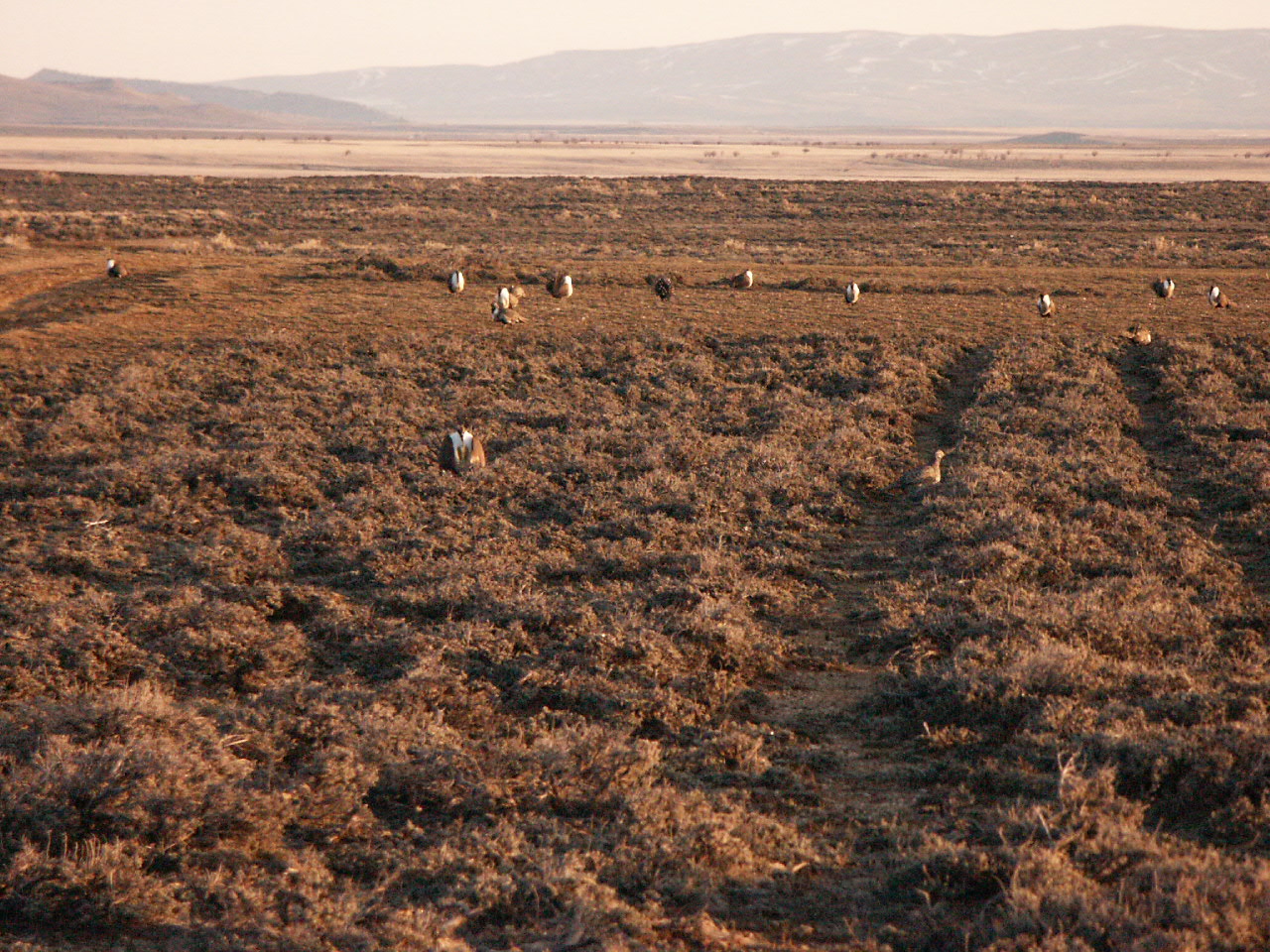
Wyoming sage grouse slumped in 2026, as long-term trend line also points down
- Mike Koshmrl WyoFile.com
The 2026 decrease at leks — where birds gather to display and attract mates in the spring — was expected: Wyoming's population cycles every nine years or so, and those swings are natural and part of basic sage grouse biology.
"The reality is, there's fewer average number of males per active lek at each of the [cycle] peaks," said Nyssa Whitford, the Wyoming Game and Fish Department's sage grouse and sagebrush biologist.
What exactly to make of the numbers is up for debate among experts. Some metrics — like lek counts during troughs in the cycle — look better for Wyoming sage grouse.
Yet other metrics signal sage grouse population declines over the last quarter century. Game and Fish tracks the "peak males" known to exist — it's a measure of the highest number of males observed at all leks biologists surveyed, even if grouse counters made only a single visit. (Not all leks are visited, but the agency's goal is to get to 90% of them annually.)
"This [declining] trend also holds true for peak males," Whitford said. "There are fewer peak males on the landscape."
When the population cycle topped out in 2006, there were over 44,000 "peak males" observed statewide, according to Game and Fish data. The measure only slightly fell to 43,329 peak males by the high point of the next cycle in 2016. But surveys clocked a sharp drop in peak males observed during the 2025 high point, with 31,123 birds observed, marking a 29% decline since 2006.
It's no secret that sage grouse, which depend on the steadily degrading sagebrush ecosystem, are in a long-term decline across their range spanning 10 western states — they were recently extirpated from North Dakota. A 2021 U.S. Geological Survey report estimated an 81% decline in the species over the preceding 53 years. Wyoming remains a stronghold — home to nearly 40% of the estimated 200,000 to 500,000 birds still on the range.
Short-term snapshot
During their spring surveys, lek count crews detected an average of 13% fewer sage grouse statewide compared to 2025. Wyoming used to divide its population into areas monitored by eight regional conservation groups, but Game and Fish dissolved those groups early this year. Now the state agency calls the regions "management areas," Whitford said. Lek counts fell in all eight of them.
Compared to 2025, the average number of male grouse decreased by 25% in southwest Wyoming, 13% in the Snake River Basin and 12% each in the Bighorn Basin, south-central Wyoming and the Wind River Basin. Birds fared slightly better in northeast Wyoming (8% decline), Bates Hole/Shirley Basin (7% decline) and the Upper Green River Basin (5% decline).
Northeast Wyoming, including the Powder River Basin, is the only area where sage grouse lek counts fell in 2025 too. Besides Jackson Hole's tiny, isolated grouse population, that northeastern region is home to the smallest and most vulnerable groups of birds in Wyoming. Population cycles run slightly differently there, Whitford said, averaging closer to seven years peak to peak.
Habitat loss from the nearly 180,000-acre House Draw Fire east of the Bighorns in Johnson County hasn't helped their cause. The first year after the 2024 wildfire converted vast tracts of sagebrush to grassland, counts of strutting males at 20 known leks within the fire scar fell by 40%. The decline continued.
"In 2024, there were 136 peak males within the fire perimeter," Whitford said of surveys before the area burned. "There were 29 peak males observed this year in the fire scar."
That's a 79% decrease, explained by what appears to be the abandonment of lek sites where the sagebrush was scorched. The number of active leks fell from eight to three between 2025 and 2026, Whitford said.
"The leks that are still active are closer to the edge," she said. "We do see this lag effect with fires. The first year, the birds are really trying. Then the second year, I think they're like, 'No thank you.'"
Sage grouse fared very differently in the Red Canyon Fire scar their first year dealing with habitat loss. That 2025 blaze in the Bighorn Basin burned in a mosaic-like pattern, and birds seem to be holding on better. There were eight active sage grouse leks in the Red Canyon Fire scar this spring, Whitford said, which is the same number as before the wildfire. Average lek counts have also held steady at 13 birds.
"We're really just not seeing much of an effect," Whitford said.
Deeper into the data
Retired Game and Fish sage grouse coordinator Tom Christiansen told WyoFile it's important to note that long-term changes in Wyoming sage grouse metrics depend on the period being examined.
"The key thing in all of these trend lines is when they start and when they end," Christiansen said. "If you went back to 1995, the line would be flatter."
For Christiansen, sage grouse population low points are more important than when the cycles are peaking.
"You have to look at the valleys," he said. "There's no doubt that numbers of grouse over the long-term have gone down. The question is, have they gone down in the last 30 years?"
The lowest sage grouse counts since the start of modern recordkeeping came in 1996, when there were an average of 12.5 males per active lek. The most recent 2013 and 2021 population troughs did not get this low, although they still slumped to 16.8, low enough for a former Game and Fish biologist to call the data "alarming."
Other sage grouse biologists don't put a ton of weight into the average-males-per-active-lek measure that Wyoming uses to track its population. That metric "obscures the reality" and is "biased in both directions," said Tom Remington, a former director of the Colorado Division of Wildlife.
"As populations increase, new leks form and by definition are small and so it tends to bring the average down of males per lek," Remington said. "And as populations bottom, you're left with the biggest leks. A lot of those peripheral leks that are transient go away, so those small numbers get taken out of the equation."
There were 15,499 peak males observed during the 2002 trough, 18,274 observed during the 2013 trough and 16,316 counted during the most recent 2021 trough.
There are likely a few years to go before Wyoming sage grouse numbers bottom out again. Based on the average nine-year cycle, the next nadir won't come until 2029 or 2030.
With vegetation sparse and parched from the warmest winter and sparsest spring snowpack on record, conditions aren't looking especially good for sage grouse.
"We have entered the downward portion of the cycle, and [the drought] is not going to help arrest that trend," Whitford said. "The habitat is key."
Christiansen, who still helps with sage grouse lek counts in the Golden Triangle, home to the largest lek on the planet, echoed the observation.
"They didn't look good to me," he said of conditions on the range.
Wyoming wildlife managers will get a sense of how sage grouse chicks fared this year come the fall hunting season, which runs from Sept. 19-30. Hunters can help biologists determine the ratio of chicks to hens — a key measure of population productivity — by dropping wings in barrels distributed around sagebrush country.