The Latin name for the snipe found in Colorado is Gallinago delicata, known as the Wilson’s Snipe. There is no “greater” or “lesser” snipe species in Colorado, although the Wilson’s Snipe was once considered a subspecies of the Common Snipe (Gallinago gallinago).
Here is a breakdown of the names and the differences between the species:
Wilson’s Snipe: This is the species found in North America and Colorado. Its Latin name is Gallinago delicata. It was formerly considered a subspecies (Gallinago gallinago delicata) of the Common Snipe.
Common Snipe: This Old World species (Gallinago gallinago) is native to Europe and Asia.
Greater Snipe: This species (Gallinago media) is not found in North America. It is a larger species of snipe native to the Old World, and is referred to as the Great Snipe.
The Latin name for the snipe found in Colorado is Gallinago delicata, known as the Wilson’s Snipe. There is no “greater” or “lesser” snipe species in Colorado, although the Wilson’s Snipe was once considered a subspecies of the Common Snipe (Gallinago gallinago).
Here is a breakdown of the names and the differences between the species:
Wilson’s Snipe: This is the species found in North America and Colorado. Its Latin name is Gallinago delicata. It was formerly considered a subspecies (Gallinago gallinago delicata) of the Common Snipe.
Common Snipe: This Old World species (Gallinago gallinago) is native to Europe and Asia.
Greater Snipe: This species (Gallinago media) is not found in North America. It is a larger species of snipe native to the Old World, and is referred to as the Great Snipe.
Once the punchline of a childhood campfire prank, Wilson’s snipe has emerged as one of the uplands’ most overlooked yet rewarding game birds. Blending the wetland settings of waterfowl hunting with the quick shots of upland bird hunting, pursuing snipe offers both challenge and table fare that rivals more celebrated species.
A Brief History
The old “snipe hunt” joke—sending an unsuspecting camper into the dark to catch a fictional bird—actually has surprising roots. In the 1950s, snipe were captured at night using truck-mounted spotlights and nets, a method that even inspired biologists studying American woodcock.
But long before that, in the 19th and early 20th centuries, snipe were one of North America’s most hunted game birds. In 1927, ornithologist Arthur Cleveland Bent claimed that more snipe had been harvested than any other species. While that’s no longer true, snipe hunting remains a legitimate, underappreciated pursuit.
What is a Wilson’s Snipe?
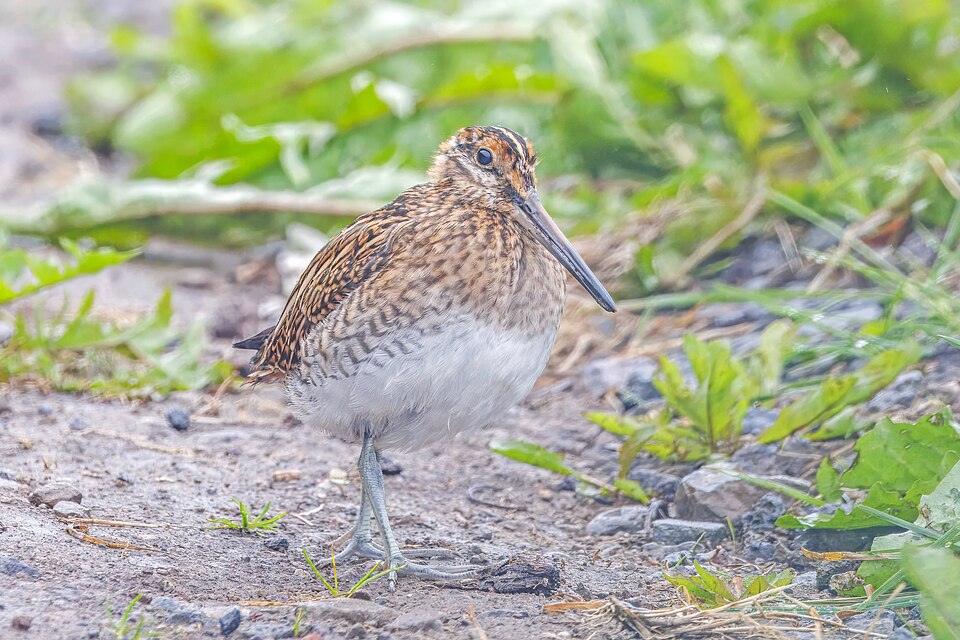
Yes, it’s a real bird. The Wilson’s snipe (Gallinago delicata) is a stocky, robin-sized shorebird with a long, slender bill and distinctive brown-and-white plumage. They’re often mistaken for woodcock or other sandpipers but can be identified by their solitary nature, zig-zagging flight, and raspy wing call.
Snipe inhabit wet meadows, marshes, and boggy riverbanks, where they probe the mud for insects and earthworms using their flexible bills.
Migration and Movement
Wilson’s snipe breed across Canada, Alaska, and the northern U.S., then migrate to wintering grounds across the southern U.S. and Mexico. A 2025 study found that some birds travel over 2,600 miles, often mixing with others from distant breeding areas—a phenomenon known as “migratory mixing.”