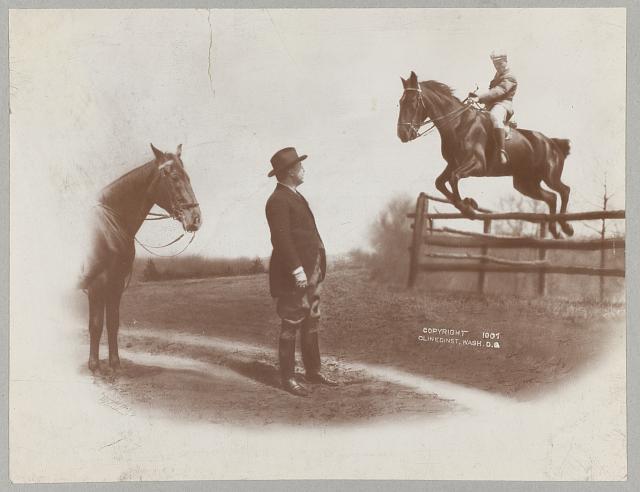
Teddy Roosevelt had a great style for adventurers to adopt, both in terms of his fashion as well as his exploits. Theodore “Teddy” Roosevelt was a lifelong equestrian, cowboy, and military commander of the [Rough Riders](https://www.nps.gov/thrb/learn/historyculture/tr-rr-spanamwar.htm) whose passion for horseback riding defined his personal philosophy and rugged public image. After personal tragedy, Roosevelt fled to the Dakota Badlands where he learned to ride hard, rope cattle, and live as a frontier ranchman, transforming his health and grit.
As lieutenant colonel of the 1st U.S. Volunteer Cavalry, he famously led parts of the advance on Kettle Hill and San Juan Hill, riding his horse Little Texas into the campaign. An avid horseman, Roosevelt routinely rode through Rock Creek Park and Potomac Park with aides, famously declaring when offered an early car that “The Roosevelts are horse people.” To prove his military physical fitness standards were realistic, President Roosevelt rode 98–104 miles on horseback from Washington, D.C., to Warrenton, Virginia, and back in a single day through freezing weather. His most famous personal mounts included a spirited hunter named Bleistein and his trusted cavalry horse Little Texas.
In his own words…. from https://www.nps.gov/thrb/learn/historyculture/tr-rr-spanamwar.htm
Who were the Rough Riders?
“Secretary Alger offered me the command of one of these regiments. If I had taken it, being entirely inexperienced in military work, I should not have known how to get it equipped most rapidly, for I should have spent valuable weeks in learning its needs, with the result that I should have missed the Santiago campaign, and might not even have had the consolation prize of going to Porto Rico. Fortunately, I was wise enough to tell the Secretary that while I believed I could learn to command the regiment in a month, yet that it was just this very month which I could not afford to spare, and that therefore I would be quite content to go as Lieutenant-Colonel, if he would make Wood Colonel. This was entirely satisfactory to both the President and Secretary, and, accordingly, Wood and I were speedily commissioned as Colonel and Lieutenant-Colonel of the First United States Volunteer Cavalry.” (pp.6 -7)
“But owing to the fact that the number of men originally allotted to us, 780, was speedily raised to 1,000, we were given a chance to accept quite a number of eager volunteers who did not come from the Territories, but who possessed precisely the same temper that distinguished our Southwestern recruits, and whose presence materially benefited the regiment. We drew recruits from Harvard, Yale, Prince ton, and many another college; from clubs like the Somerset, of Boston, and Knickerbocker, of New York; and from among the men who be longed neither to club nor to college, but in whose veins the blood stirred with the same impulse which once sent the Vikings over sea.” (p. 9-10)
“Then I went down to San Antonio [Texas] myself, where I found the men from New Mexico, Arizona, and Oklahoma already gathered, while those from Indian Territory came in soon after my arrival. These were the men who made up the bulk of the regiment, and gave it its peculiar character. They came from the Four Territories which yet remained within the boundaries of the United States; that is, from the lands that have been most recently won over to white civilization, and in which the conditions of life are nearest those that obtained on the frontier when there still was a frontier….” (p. 14-15)
“All—Easterners and Westerners, Northerners and Southerners, officers and men, cow-boys and college graduates, wherever they came from, and whatever their social position—possessed in com mon the traits of hardihood and a thirst for adventure. They were to a man born adventurers, in the old sense of the word.” (p. 19)
“The life histories of some of the men who joined our regiment would make many volumes of thrilling adventure.” (p. 24)
“There was Bucky O’Neill, of Arizona, Captain of Troop A, the Mayor of Prescott, a famous sheriff through out the West for his feats of victorious warfare against the Apache, no less than against the white road-agents and man-killers….Allyn Capron, who was, on the whole, the best soldier in the regiment. In fact, I think he was the ideal of what an American regular army officer should be. He was the fifth in descent from father to son who had served in the army of the United States, and in body and mind alike he was fitted to play his part to perfection. Tall and lithe, a remarkable boxer and walker, a first-class rider and shot, with yellow hair and piercing blue eyes, he looked what he was, the archetype of the fighting man. He had under him one of the two companies from the Indian Territory; and he so soon impressed himself upon the wild spirit of his followers, that he got them ahead in discipline faster than any other troop in the regiment, while at the same time taking care of their bodily wants. His ceaseless effort was so to train them, care for them, and inspire them as to bring their fighting efficiency to the highest possible pitch. He required instant obedience, and tolerated not the slightest evasion of duty; but his mastery of his art was so thorough and his performance of his own duty so rigid that he won at once not merely their admiration, but that soldierly affection so readily given by the man in the ranks to the superior who cares for his men and leads them fearlessly in battle.” Roosevelt, Theodore, Rough Riders, (p.18-19)
“From the Indian Territory there came a number of Indians —Cherokees, Chickasaws, Choctaws, and Creeks. Only a few were of pure blood. The others shaded off until they were absolutely indistinguishable from their white comrades; with whom, it maybe mentioned, they all lived on terms of complete equality…One of the gamest fighters and best soldiers in the regiment was Pollock, a full blooded Pawnee. He had been educated, like most of the other Indians, at one of those admirable Indian schools which have added so much to the total of the small credit account with which the White race balances the very unpleasant debit account of its dealings with the Red. Pollock was a silent, solitary fellow—an excellent pen man, much given to drawing pictures.” Roosevelt, Theodore Rough Riders (p. 20-21)
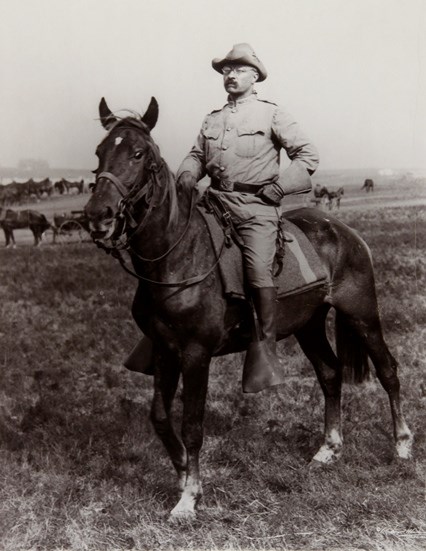
Colonel Theodore Roosevelt in Cuba- 1898
Theodore Roosevelt Collection, Houghton Library, Harvard University