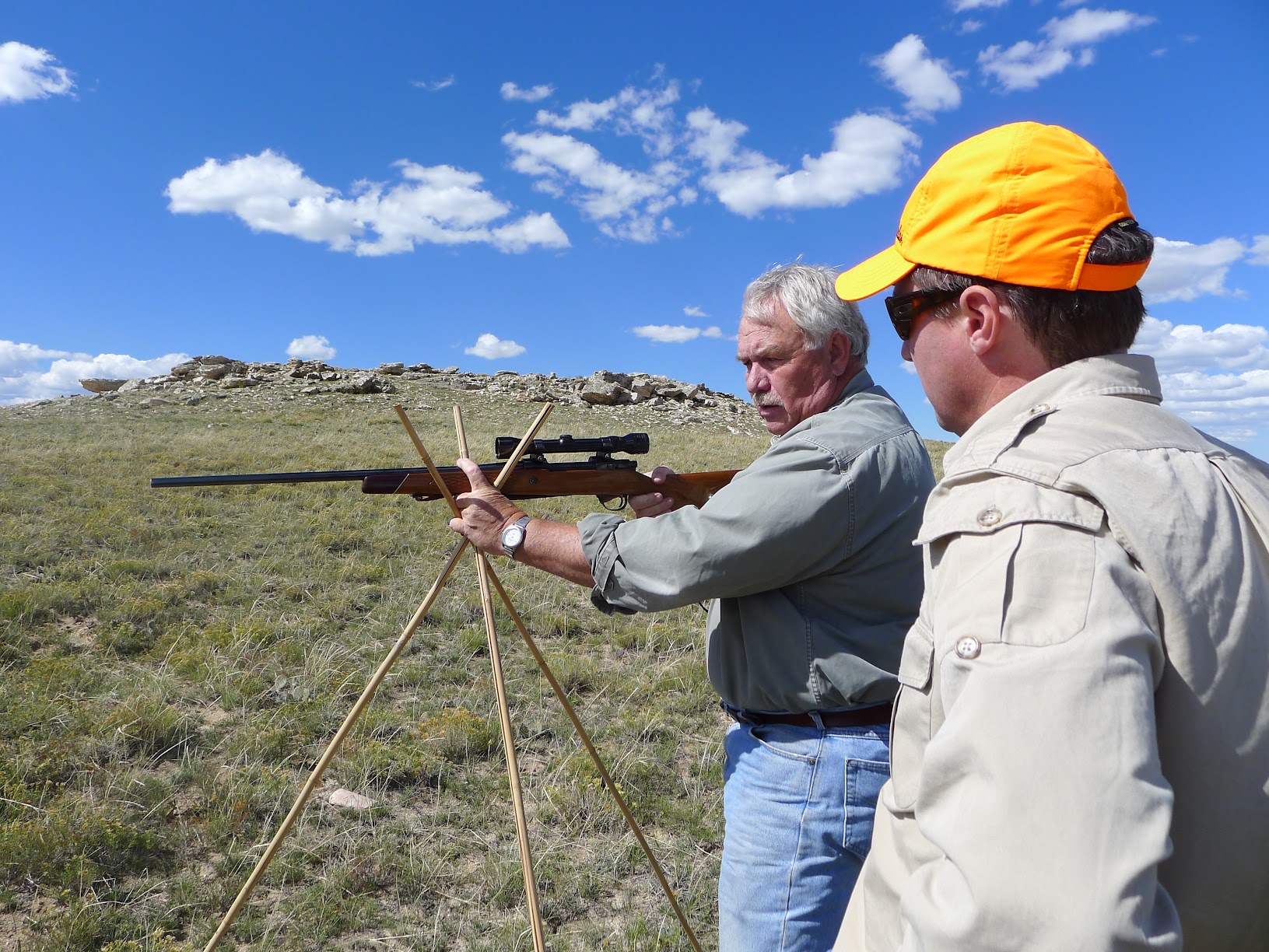
The Art of the Shooting Stick
Why a simple tripod may be one of the most important pieces of equipment in a hunter’s kit
Campfire debates about rifles and cartridges are part of the fun of hunting. Hunters can spend an entire evening arguing over bullet weight, velocity, caliber and the relative merits of one rifle over another. But when the time comes to make the shot, there is a much simpler truth: how well you shoot matters more than what you are shooting.
That is where shooting sticks enter the story.
For anyone who has hunted Africa, three-legged shooting sticks are hardly an accessory. They are part of the language of the hunt. When a stalk begins, the professional hunter carries his rifle, a tracker carries the sticks, and the hunter knows that sooner or later those three legs may become the foundation for the shot of the trip.
There is a practical reason for their ubiquity. African bush is not particularly interested in accommodating a prone shooting position. Thorny vegetation makes lying on the ground an unattractive proposition, while taller grass, brush and uneven terrain often make a low position impossible. Standing behind a set of sticks allows the hunter to shoot over the vegetation while maintaining a remarkably stable platform.
The beauty is in the simplicity.
Three Legs and a Rifle
A good set of shooting sticks does not attempt to replace the hunter’s skill. It simply gives that skill a better foundation.
The traditional African tripod is wonderfully uncomplicated: three legs, a slightly shorter front leg, and a fork at the top where the rifle’s fore-end rests. The system is fast, quiet and adaptable. Once properly positioned, the hunter can settle the rifle, establish a natural shooting position and concentrate on the only thing that really matters.
The sticks from African Sporting Creations follow that same philosophy, while adding the craftsmanship and portability expected from purpose-built field equipment.
Their Domestic Wood Take-Down Shooting Sticks are made from domestic hardwood and stand approximately 70 inches when fully assembled. They separate into two sections of roughly 36 inches, allowing them to fit inside a full-length, airline-approved gun case without becoming another awkward piece of luggage to manage.
And at less than 2.5 pounds, they are remarkably light.
That matters more than it might sound. Hunting is an exercise in accumulated weight. Rifle, ammunition, binoculars, rangefinder, water, optics, clothing and everything else eventually finds its way onto your body or into your pack. Equipment that provides meaningful stability without adding unnecessary weight earns its place very quickly.
The Right Height Is Everything
The first lesson in shooting sticks is simple: they have to fit the shooter.
A set that is too tall can leave the hunter reaching upward or standing awkwardly. Too short and the shooter is forced to lean excessively forward. Neither is ideal when the objective is to create a stable, repeatable shooting position.
The sweet spot is personal.
With the sticks spread and the rifle settled into position, the junction should allow the shooter to stand naturally, feet slightly apart, with a modest forward lean into the support. That creates a solid foundation rather than a balancing act.
This is particularly important on safari because the person managing the sticks may not be the person doing the shooting. A professional hunter or tracker may be considerably taller or shorter than his client. The proper height should therefore be established before the moment arrives.
The sight-in session at the beginning of a hunt is the perfect opportunity to do it.
Shoot from the sticks. Adjust the height. Shoot again. Find the position that feels natural, then make sure the person handling the sticks understands exactly where you want them.
It is not complicated. It is simply something that is better learned before a magnificent animal is standing in front of you.
Practice Before the Moment
Shooting sticks are easy to use. Becoming good with them is something else.
The first day of a safari is a poor time to discover that you have never actually shot from a tripod.
The basic movement should become automatic. The front leg is planted in the direction of the shot, while the other two legs are drawn back evenly to create the V-shaped rest. The rifle’s fore-end, not the barrel, belongs on the intersection of the sticks.
From there, hand placement becomes a matter of personal preference.
Some hunters hold the fore-end behind the sticks. Others reach forward. The important thing is to find a position that allows the supporting hand to control the rifle while maintaining consistent pressure against the sticks.
The goal is not to fight the rifle or the sticks. It is to connect the shooter, rifle and support into one stable system.
That takes practice.
And practice does not necessarily mean burning through boxes of ammunition. Dry practice, mounting the rifle, establishing the position and learning to settle naturally into the sticks can build much of the necessary familiarity before a single round is fired.
Why Wood?
Modern shooting supports come in nearly every material imaginable. Aluminum, carbon fiber and highly adjustable mechanical systems have made shooting rests lighter, faster and more sophisticated.
There is certainly a place for that technology.
But there is also something deeply satisfying about wood.
The Domestic Wood Shooting Sticks are available in red oak, a durable and attractive domestic hardwood. The oak is finished with clear polyurethane, while the connectors are sandblasted for a subdued appearance.
For hunters who want maximum rigidity, the hickory upgrade is particularly appealing.
Hickory is exceptionally tough and rigid, the same species traditionally chosen for demanding applications such as axe handles. The shafts are kiln-dried to remove moisture and then finished with a medium-brown polyurethane stain that helps them disappear into the surroundings.
The result is a piece of equipment that feels substantial without being heavy and traditional without being old-fashioned.
Fully Loaded
For those who want the complete package, the Fully Loaded configuration adds several thoughtful upgrades.
The hickory shafts provide increased rigidity, while matte-black anodized connectors reduce glare and give the sticks a more subdued field appearance. The tops are hand-sewn, and a heavy-duty canvas carrying case keeps everything together when traveling.
The sticks are available in Large for hunters approximately 5’9″ to 6’1″. Hunters taller than 6’1″ are better served by the XL configuration, which is offered exclusively with the upgraded hickory shafts.
There are also opportunities to personalize the sticks.
Zebra or Cape buffalo hide can be used for the top coverings, adding a distinctly African character. A Courteney Cape buffalo carrying case takes that idea a step further. For hunters using either bolt-action or double rifles, the optional bridge top provides another method of securing the rifle into the rest.
None of these additions are necessary to make the sticks work.
That is precisely why they are enjoyable.
They are details chosen by someone who spends enough time in the field to appreciate the difference between equipment that merely functions and equipment that feels right.
The Advantage of Three Legs
There are plenty of alternatives.
Monopods are fast and wonderfully portable. Bipods can provide excellent support. Modern adjustable systems can move from prone to standing positions and accommodate uneven ground with impressive speed.
But there is something particularly effective about the three-legged design.
Three points create a remarkably stable platform while allowing the hunter to remain standing. The system is fast to deploy, relatively quiet and forgiving of uneven terrain. Most importantly, there are no complicated adjustments to make when an animal suddenly appears.
For a hunter who values simplicity, that matters.
The less there is to manipulate between spotting an animal and taking the shot, the better.
It is also why three-legged sticks have remained so common in Africa despite the arrival of increasingly sophisticated alternatives. Their design has already solved the problem.
When One Set Isn’t Enough
There are situations where two sets of sticks can provide another level of stability.
The first set can be used conventionally beneath the rifle’s fore-end, while a second set supports the rear of the rifle near the butt. With the two supports properly adjusted, the rifle can become remarkably stable, approaching the steadiness of a much more substantial shooting position.
There are faster variations as well, including using a second set to stabilize the shooting-side elbow.
These techniques are specialized, and they are certainly not something to improvise when the animal of a lifetime is standing in the distance. But they illustrate an important principle: shooting sticks are not simply a place to rest the rifle. They are a system for building a stable shooting position in terrain where a bench, prone position or conventional rest may not exist.
The Shooting Stick as Part of the Hunt
Perhaps that is why a well-made set of sticks becomes more than equipment.
After enough time hunting, you begin to appreciate the objects that quietly make the experience better. A rifle that fits your hands. A pair of binoculars that seems to disappear around your neck. A knife that has developed its own patina. Boots that have traveled enough miles to know the country.
Shooting sticks belong in that category.
They are there when the stalk begins. They move silently through the bush. They plant into sand, soil or rock. They give the rifle a steady home when the heart is beating a little faster than usual.
And then, when the moment arrives, they largely disappear from your attention.
That is the mark of good equipment.
The finest field gear does not demand to be noticed. It simply does its job, over and over, until one day you realize you cannot imagine hunting without it.
The core idea is simple: shooting sticks are only useful if you can use them instinctively. The following is a polished Part Two that keeps the practical lessons from the original while making it read more like a refined outdoor-lifestyle article rather than a transcription. I’ve also framed it so it follows naturally from Part One. Humanity has apparently decided that even standing still requires practice.
Stick-Ology, Part Two: The Key Is Practice
In Part One, we looked at the many ways shooting sticks can add stability in the field. But owning a good set of sticks is only the beginning. The real advantage comes from learning to use them so naturally that setting up for a shot becomes almost automatic.
There are two parts to becoming proficient with shooting sticks: stability and speed.
You need to become steady enough to make the shot, but you also need to get into that stable position quickly. In the field, the clock is almost always running. An animal rarely stands patiently while a hunter experiments with equipment, adjusts leg height, searches for the perfect position, and generally negotiates with gravity.
Professional hunters and guides frequently comment on the shooting ability of their clients. Some hunters simply aren’t very good shots. But an equally common problem is that hunters are too slow. They may eventually find a stable position, but by then the opportunity has disappeared.
The solution is practice.
Learn Before You Hunt
The first time I encountered what were commonly called African shooting sticks was on my first safari, during what was essentially a range day. I had read dozens of books about hunting in Africa, yet somehow the subject of shooting sticks had never registered.
That was then. Today, there is no shortage of information about shooting sticks, and virtually every experienced African professional hunter expects his clients to have at least some familiarity with them.
I have been preaching the value of shooting sticks for decades, yet I still encounter hunters in camp who have never used them.
They usually figure it out.
Eventually.
But learning in camp can be an expensive way to develop a new skill. A missed opportunity, or worse, a poorly executed shot, is a poor substitute for preparation at home.
A friend, Ron Silverman, once asked me what he could do to prepare for his first safari. My answer was immediate:
Get a set of shooting sticks and practice using them both accurately and quickly.
He took the advice seriously.
The following spring, he sent me a photograph of an impressive group he had fired from sticks with his .308 at 300 yards. Five shots were grouped within four inches, with one flyer just outside.
I’ll admit it: standing off sticks, I couldn’t duplicate that group at 300 yards.
Fortunately, we don’t need to.
For most hunters, the goal isn’t to turn shooting sticks into a benchrest. The goal is to become confident and competent at the distances and positions likely to occur in the field. With consistent practice, most hunters can become comfortable shooting from sticks at 150 yards and beyond.
More practice can extend that envelope considerably.
Find a System That Works for You
Shooting sticks don’t have to be complicated. You can make your own, purchase a traditional set, or choose from the many modern systems now available.
Personally, I like sticks that can be adjusted for different shooting positions, particularly sitting and kneeling. The more options you have for creating a stable position, the better prepared you are for changing terrain and unexpected opportunities.
The important thing isn’t finding the most sophisticated system.
It’s finding your system.
Once you do, keep it with your rifle and take it with you. Shooting sticks that are sitting at home in the garage aren’t going to be particularly helpful when the opportunity of a lifetime appears across a canyon.
Learn to Deal With Bad Ground
There is another aspect of shooting sticks that only becomes obvious with experience: the ground matters.
Uneven terrain, loose soil, rocks, slick grass, or a poorly placed leg can turn a stable shooting position into an unstable one in an instant.
And, naturally, this tends to happen at precisely the wrong moment.
One leg can slip or kick loose just as you’re settling behind the rifle. The ability to recognize the problem and correct it quickly is every bit as important as learning how to establish a stable position in the first place.
Practice changing the height of the sticks.
Practice repositioning them.
Practice recovering when one leg moves.
Eventually, the adjustments become automatic.
That familiarity can save precious seconds when an animal is standing in front of you.
Practice Doesn’t Have to Hurt
There’s no reason to burn through expensive ammunition, punish your shoulder, or heat your rifle barrel simply to learn how to shoot from sticks.
A .22 rimfire is an excellent practice tool. It gives you the opportunity to work on position, balance, trigger control, and follow-through without the recoil, noise, and expense of a centerfire rifle.
A pellet rifle can serve the same purpose.
You can even practice the mechanics of mounting the rifle, establishing your position, and acquiring a sight picture with an unloaded rifle during dry-fire practice. The important thing is to build the movements into muscle memory.
The goal is not merely to become a better shot.
The goal is to become efficient.
When the moment arrives, you want the rifle, the sticks, and your body to come together almost without conscious thought.
Practice Makes the Difference
The best shooting position in the world is useless if you can’t establish it quickly.
Likewise, the fastest setup in the field doesn’t matter if the rifle isn’t stable when you finally get there.
Practice brings the two together.
Spend time shooting from sticks. Practice standing, kneeling, and sitting. Practice on level ground and uneven ground. Learn how your particular sticks behave, how quickly you can adjust them, and how much movement you can make without disturbing the rifle.
Then take them hunting.
By the time you arrive for your next safari, range day shouldn’t be the first time you have ever used your shooting sticks. It should simply be the place where you confirm what you already know.
The objective is wonderfully uncomplicated: when the opportunity comes, you should be ready.
Not simply learning how to stand behind shooting sticks, but learning how to make them disappear into the process of making a good shot.
This version also sets up Part Three nicely if you want to continue the series into specific shooting-stick techniques, positions, drills, and field situations.
For the serious hunter, particularly one who spends time pursuing game in Africa, a set of shooting sticks is not an accessory.
It is part of the shooting position, part of the ritual and, ultimately, part of the hunt.