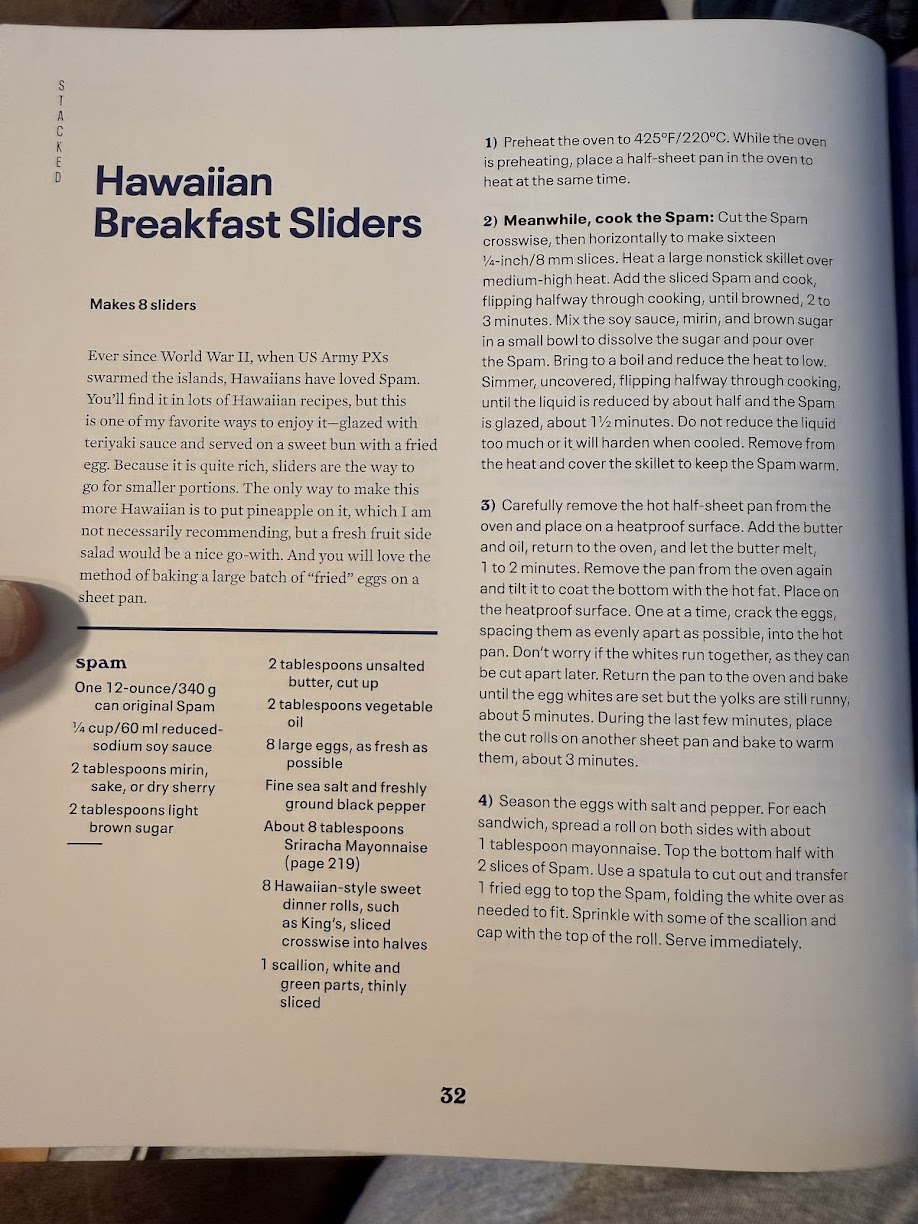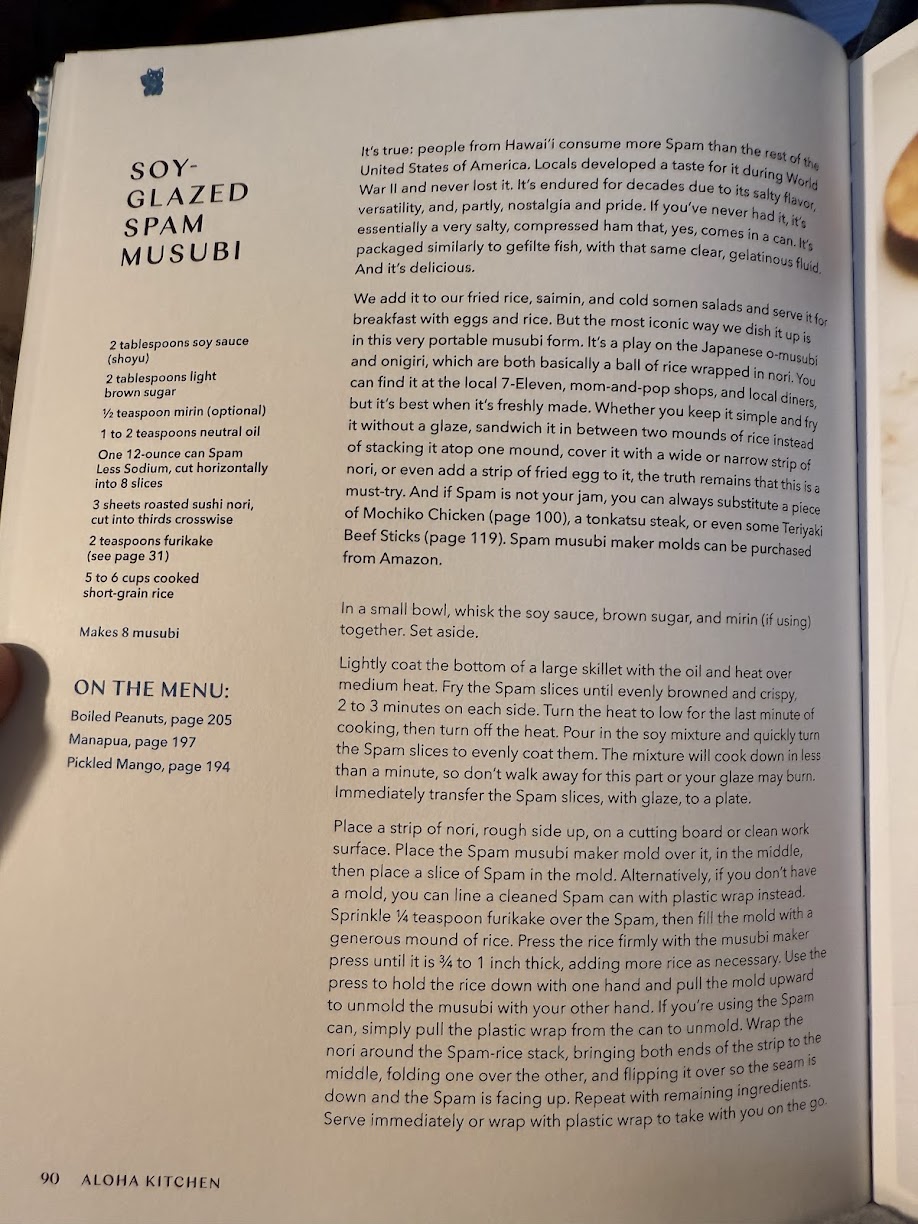
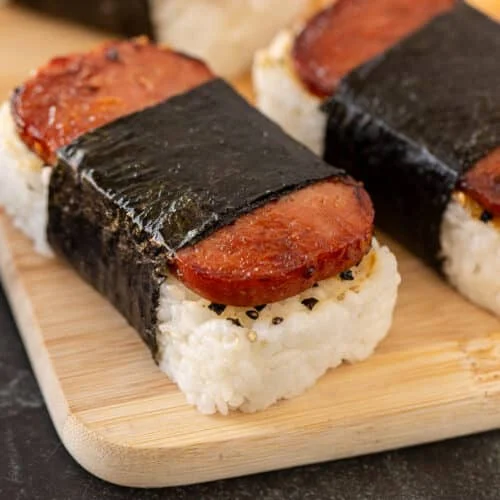
Spam Musubi
You are never far from a Spam musubi in Hawai‘i, thanks in large part to 7-Eleven. The convenience store chain sells so many that it reportedly requires an entire pallet of Spam every day to stock its island locations — thousands of cans and even dedicated employees whose job is simply opening them for hours at a time. Hawaiians love Spam musubi: compact blocks of rice topped or layered with Spam, wrapped in nori, and carried everywhere as an easy snack or quick meal in the car.
Like many dishes tied to wartime history, Spam musubi traces its roots to the arrival of the U.S. military in Hawai‘i. After the bombing of Pearl Harbor in 1941, thousands of Japanese Americans were sent to internment camps, where early versions of Spam-and-rice dishes became common. Prisoners would layer sliced Spam over pans of rice and cut them into portions, much like sheet cake. The modern Spam musubi, however — inspired by Japanese onigiri — did not become widely popular until the 1970s and 1980s.
Today, Spam musubi appears in countless variations, often paired with ingredients such as bacon and eggs, pickled plum, avocado, or fragrant shiso leaf. At Mana Musubi, owner Manabu Asaoka prepares each musubi with the precision and care of a sushi chef.
Makes 12
Ingredients
- 1/2 cup soy sauce (shoyu)
- 1/2 cup sake
- 1/4 cup granulated sugar
- 1 can (12 ounces) Spam
- 3 cups uncooked short-grain white rice
- 6 sheets nori, cut in half to make 12 strips
Note
If you do not have a rectangular musubi mold, an empty Spam can lined with plastic wrap works perfectly. Leftover musubi can be wrapped tightly and refrigerated for up to 2 days.
Instructions
Cook the Rice
Rinse the rice under cold water until the water runs clear. Combine the rice and 3 3/4 cups water in a pot and let sit for 15 minutes. Bring to a gentle simmer, cover, reduce the heat to low, and cook for 20 minutes.
Transfer the cooked rice to a large bowl or tray and let it rest for about 10 minutes, until the steam naturally dissipates.
Prepare the Spam
In a saucepan, combine the soy sauce, sake, sugar, and 2 cups water. Bring to a low simmer and stir until the sugar dissolves, about 5 minutes.
Slice the Spam into 12 thin pieces and add them to the saucepan. Simmer gently for 1 to 2 hours, adding small splashes of water as needed to maintain the liquid level.
Transfer the Spam slices to a tray lined with foil and blot away excess liquid with paper towels. Using a kitchen torch or a broiler set to high, lightly char each side until browned and caramelized.
Assemble the Musubi
When the rice is warm but no longer steaming, place about 2 tablespoons of rice into a musubi mold. Top with a slice of Spam and gently press down using the mold’s press plate.
If using a Spam can instead of a mold, line it with plastic wrap, fill with rice and Spam, and press firmly with a flat tray or plate until compact and smooth.
Remove the musubi from the mold and place it on a strip of nori. Wrap the nori snugly around the rice and Spam, sealing the edge with a dab of water. Repeat with the remaining ingredients and serve warm or at room temperature.

______________________________________________________________________________________________
Maple-Candied Spam
Serves 4 to 6
Ingredients
- 1 (12-ounce) can SPAM, sliced 1/4 inch thick
- 1/4 cup maple syrup
- 1/2 teaspoon garlic powder
- Toasted sesame oil
Instructions
- Arrange the sliced Spam evenly on a sheet pan and place it into a cold oven. Turn the oven to 400°F and roast until the slices are browned and crisp around the edges, about 25 minutes.
- While the Spam cooks, stir together the maple syrup and garlic powder in a small bowl.
- Remove the pan from the oven and drizzle the maple-garlic syrup over the Spam. Return the pan to the oven and roast until the syrup bubbles and thickens into a glaze, about 10 minutes more. Keep a close eye on it so the sugars don’t burn.
- Lightly coat a serving plate with toasted sesame oil. Transfer the Spam to the plate and let it cool slightly. The glaze will continue to harden and become glossy as it cools.
Spam Fried Rice
Serves 4 to 6
Ingredients
- 3 cups day-old cooked short-grain rice, at room temperature
- 1 tablespoon sesame oil
- Neutral oil, for frying
- 1/2 (12-ounce) can SPAM Less Sodium, cut into 1/4-by-1-inch matchsticks
- 1 cup finely diced carrots (about 1 1/2 carrots)
- 1 cup finely diced Maui or yellow onion (about 1/2 onion)
- Kosher salt and freshly ground black pepper
- 1 cup chopped green onions, white and green parts (about 4 green onions)
- 1 teaspoon very finely grated garlic (about 2 cloves)
- 1 tablespoon soy sauce (shoyu)
- 1 tablespoon oyster sauce
- 1 teaspoon Worcestershire sauce
- 2 large eggs, lightly beaten
- 4 to 6 fried eggs, for serving (optional)
On the Menu
- Takuan
- Side salad with guava dressing
- Guava cake
I’m not really a leftovers person. It’s not that I won’t eat them — I’d just rather make something new every night. Fried rice is one of the few exceptions. To me, it’s one of the best ways to reinvent leftovers into something better than the original meal. Day-old rice, forgotten vegetables, and bits of leftover meat all find a second life in the pan.
And if you don’t happen to have leftover meat around, Spam fried rice always delivers. Every culture — honestly, every household — has its own version of fried rice, but this is the one I grew up eating. If you believe fried rice should stay simple with just carrots, onions, and Spam, stick with the recipe as written. If you like experimenting, toss in whatever’s in the fridge: frozen peas, chopped chicken, steak, or leftover green beans all work beautifully.
A fried egg on top is highly recommended, along with ketchup or sriracha if that’s your thing. Some people even add mayo. I haven’t gone that far myself, but I respect the commitment.
Instructions
- In a bowl, toss the rice with the sesame oil until evenly coated. Set aside.
- Heat a wide skillet or wok over medium heat and add 1 to 2 teaspoons neutral oil. Fry the Spam for about 1 minute per side, until lightly crisped and browned all over. Transfer to a bowl and set aside.
- Reduce the heat to medium-low and add 1 to 2 tablespoons neutral oil. Once shimmering, add the carrots and onion. Stir-fry until softened and mostly translucent, about 4 to 5 minutes. Season with salt and pepper.
- Increase the heat to medium. Add 1/2 cup of the green onions and cook for another minute. Stir in the rice, garlic, soy sauce, oyster sauce, Worcestershire sauce, and cooked Spam. Break up the rice with a spoon or spatula as you stir-fry. Cook until the rice is heated through and the sauces are fully absorbed, about 4 to 5 minutes. Taste and adjust seasoning as needed.
- Create a well in the center of the rice and pour in the beaten eggs. Let them sit undisturbed for 30 seconds, then gently scramble. Wait another 30 seconds and scramble again, gradually pulling rice into the eggs. Repeat until the eggs are fully cooked and evenly incorporated throughout the fried rice.
- Turn off the heat and let the fried rice rest in the pan until ready to serve. Top with the remaining green onions and serve with fried eggs, if desired.