Wingshooting

Epanuel Breton

I was worried that in recent years America's friendship the people of France had waned in light of U.S.'s war with Iraq.  This caused the boycott of French fries in France or the re-naming of them as "Freedom Fries," among other headlines.  But, my experiences in France, and even recent ones, have been evidence to the contrary.  My French friends are lasting allies and even the passing stranger remains happy to help an American tourist, especially in the countryside where we like to spend most of our time. In addition to the French fries, which aren't really French, the French also gave us the Statue of Liberty and the French Brittany, the Epagnuel Breton, or Epanuel Breton.  My friend, Andy Wayment writes, "Before the French Revolution, France was an absolute monarchy with feudal privileges in the aristocracy. Under this regime, land in France was owned mainly by a privileged few. This meant that hunting and fishing could only be enjoyed by the noblemen and their fortunate guests. Generally, the common man was not allowed to enjoy these sports.  Legend has it that the Brittany was developed by the French peasants as the ideal poaching dog. As so aptly described by Michael McIntosh in A Feisty Little Pointing Dog, the Brittany was bred to be 'compact andbidable, close-working and quiet, the perfect accomplice for clandestine sport and the companion of choice among those whose favorite game was someone else's.' The landed nobles, with their big running pointers and setters, did not recognize these shaggy, tailless mongrels for what they were, bona fide hunting machines. Of course, this was all part of the ruse. Brittanys are pointers with the natural instinct to retrieve. Because of its noble history, the French Brittany was destined to arrive

By |September 24th, 2011|Categories: Dog Training, Wingshooting|Comments Off on Epanuel Breton

Garbi Shotguns

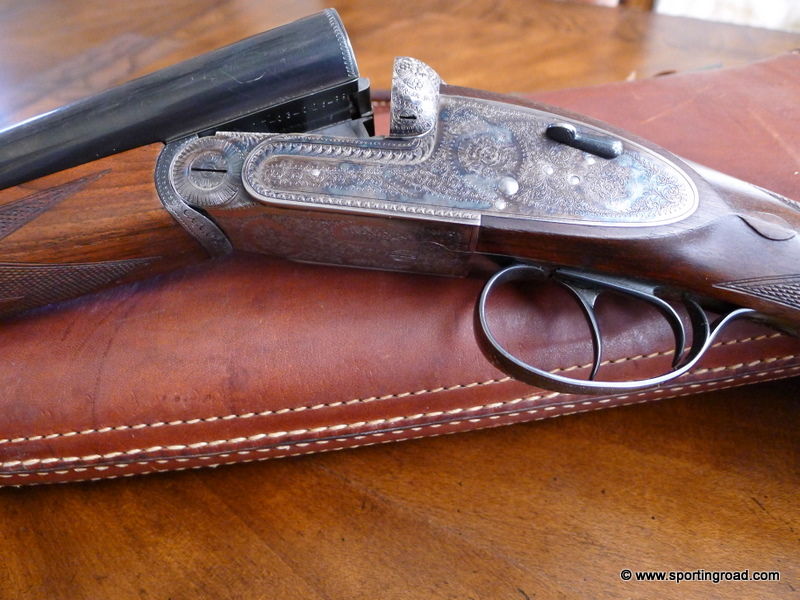
For our method of instinctive shooting, we'll use a side-by-side shotgun, straight stocked with splinter forend.  While a boxlock is surely the simplest of the side-by-side Best Guns of London, an Anson & Deeley Action (boxlock), a sidelock Best Gun is surely the prettiest.  As my father-in-law used to say, "Get the best guy you can afford my boy and learn how to use it."  I went for the Garbi, once I had sufficient income in which to upgrade from Ugartecheas and Parkers.  Armas Garbi guns are manufactured in Eibar, in the Basque gun making region in the north of Spain. Garbi is a Basque word, which means, “clean” and is an acronym formed from the initials of the names of the firm’s founders. “G” is for Guerrena Barrena, in charge of scale adjustments. “A” is for Alday, head of the engravers. “R” is for R. Churruca, who is in charge of assembly and final finish. “B” is for Barrenechea, the general manager of the company. “I” is for Irondo, an expert in adjustments and finishing of stocks. William Larkin Moore & Co. has been importing the fine line of Garbi shotguns since 1975 and we have had excellent success with them. Garbi guilds a traditional English style gun based on the Holland & Holland type sidelock action. These guns feature chopper lump barrels, automatic ejectors, hand detachable locks and articulated front triggers. Most instinctive shooters will be sporting about ¼ inch of cast-off, 1 ½ inch of drop at the comb and about 4 degrees of pitch.  These become the magic wands with which Buz Fawcett creates Master Gunners. Confidence is the key to Master Gunning.  You are a 100% shooter.  You should be hitting 24/25 skeet shots within a year.  You can hit

By |September 24th, 2011|Categories: Wingshooting|Comments Off on Garbi Shotguns

Ugartechea

For our method of instinctive shooting, we'll use a side-by-side shotgun, straight stocked with splinter forend.  While a boxlock is surely the prettiest of the side-by-side Best Guns of London, an Anson & Deeley Action (boxlock) will not shoot any different than a sidelock Best Gun.  Most instinctive shooters in our instinctive shooting tradition will be sporting about ¼ inch of cast-off, 1 ½ inch of drop at the comb and about 4 degrees of pitch.  These become the magic wands with which he creates Master Gunners. Confidence is the key to Master Gunning.  You are a 100% shooter.  You should be hitting 24/25 skeet shots within a year.  You can hit at 65-80 yards, which we practice at the Tower in the school, although it would not be fair to a bird.  I hit 95% during the school. . While it may vary, I am 5’10” and 175 pounds and have a 13 5/8” or 13 3/4” length of pull, with 2 1/8” or 2 1/4” drop at heel, with 3/8” cast off and 1 ½” at 16” down pitch without a pad or 0-1/2” at 26” with a pad.  Forcing cones are reduced to 2 ½”, with everything polished to final dimensions. Pattern any gun by taking 10 shots, averaging the results by overlapping the shot spray) at 16 yards on a single sheet of paper.  For each 1” correction on paper, move the stock 1/16 inch in each direction. 12 gauges fits most men’s hands best and with the light loads, it’s effectively a 20 gauge being shot. 20 gauges fits most women best and with the light loads it’s a .28 gauge.  Gun weight in a 20 gauge is ideal at 5 pounds 4 ounces, and a 6

By |September 24th, 2011|Categories: Wingshooting|Comments Off on Ugartechea

Check Cords

Check cords should be made of 3/8" nylon and 20' in length with a bowline knot and a brass snap. They used to be available from only one gun dog supplier in the south and now this is the closest you will find to the correct stiffness from Cabella's. Gary Ruppel demonstrates his famous half-hitch, which is a trick used to acquaint foals with saddling, and it works great on bird dogs to change the point of contact from the collar to the flank.  Gary uses it frequently in teaching heel, whoa, and other commands.  I am always surprised at its effectiveness and the simple fact that few other trainers have learned this technique.

By |July 16th, 2011|Categories: Dog Training, Wingshooting|Comments Off on Check Cords

Basics of Bird Dog Training by Bill Tarrant

Bill Tarrant has been a correspondent, bureau chief and editor for Reuters in Asia for the past 22 years.  He wrote extensively on bird dogs and was an interesting character who I was grateful to have met a couple of time with Gary Ruppel and Mike. Basics of Bird Dog Training article by Bill Tarrant Part I and Part II.

By |July 16th, 2011|Categories: Book Reviews, Wingshooting|Comments Off on Basics of Bird Dog Training by Bill Tarrant

Mike Gould’s Whoa Post

This is the full article on the Whoa Post that we use, as described in this article by Bill Tarrant. Here's a brief summary: The Whoa Post: Teaching a Dog to Stand Still Perhaps the defining behavior of a bird dog is its ability to slam on the brakes and become motionless the instant it encounters bird scent. This instinctive stop is what separates a bird dog from other breeds and is a trait that has been carefully selected and refined over hundreds, if not thousands, of years. Very few dogs, however, possess a perfect point from the start. A reliable point is a behavior that must be shaped, developed, and reinforced until it becomes second nature. While there are many ways to teach a dog to stand still, years of experience and generations of training have convinced us that the Whoa Post is one of the clearest and most efficient methods available. We have used it successfully with thousands of dogs. The primary purpose of the Whoa Post is to teach the dog that pressure or a cue applied to the flank means stop and stand still. Through repetition, the dog develops a conditioned response to that cue. Although the Whoa Post can be used to address many other training issues and offers numerous additional benefits, its fundamental objective should never be forgotten: teaching the dog to stand still when cued. To begin Whoa Post training, select a suitable training area. Any open space with enough room to secure your dog to the post using a check cord and several wraps will work. Ideally, choose a location with minimal distractions—away from your bird pen and separate from the areas where you conduct bird

By |July 16th, 2011|Categories: Dog Training, Wingshooting|Comments Off on Mike Gould’s Whoa Post