
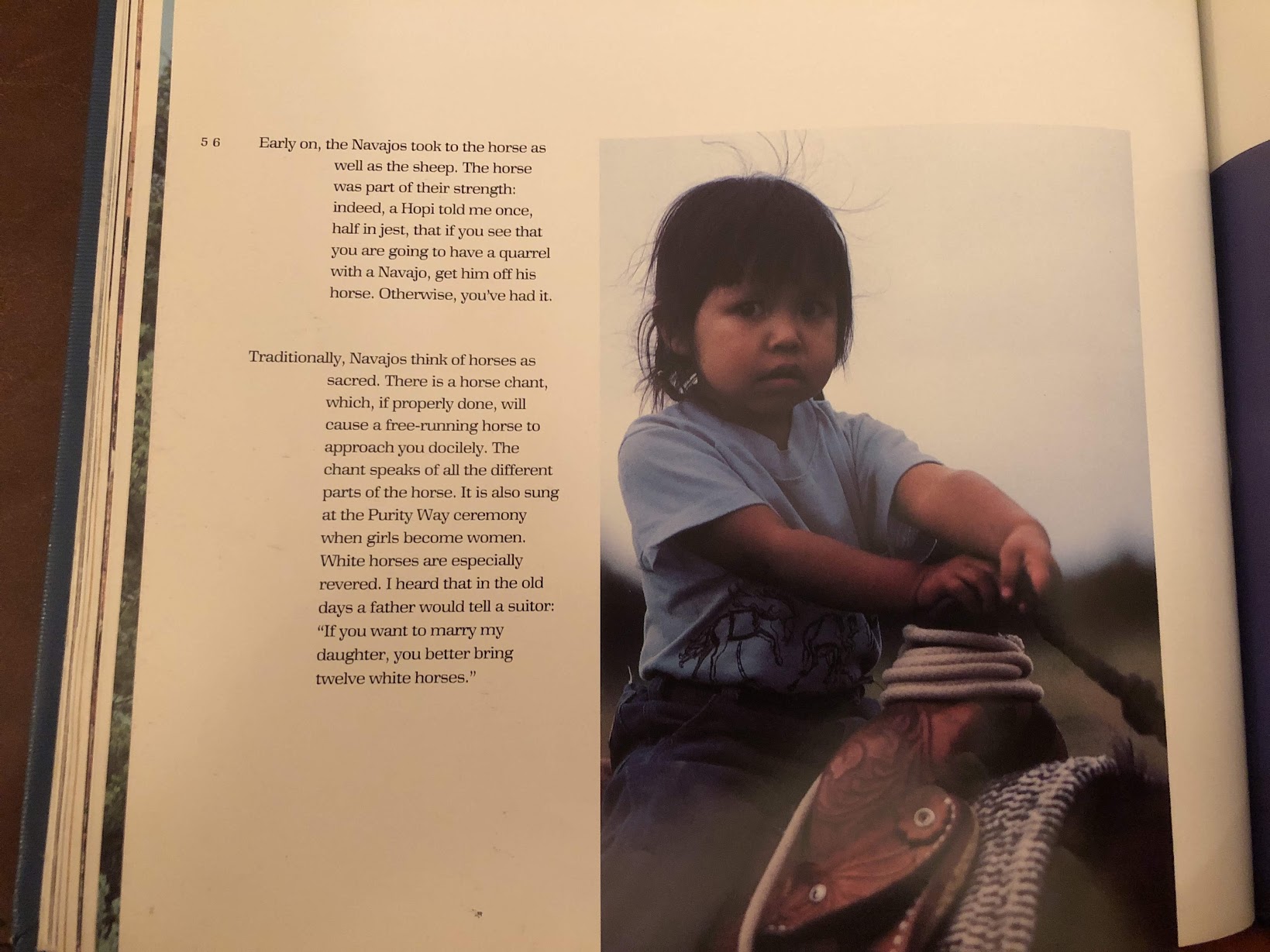
Diné (Navajo) horsemen traditionally sing to their herds to establish spiritual harmony (hózhǫ́), mutual trust, and deep calm. Rather than “docile” a horse through force, the chanting shares a peaceful energy that wild or restless animals sense and respond to. The words of the traditional song translate as:
How joyous his neigh!
Lo, the Turquoise Horse of Johano-ai,
How joyous his neigh,
There on precious hides outspread, standeth he;
How joyous his neigh,
There of mingled waters holy, drinketh he;
How jurisdictions his neigh,
There in mist of sacred pollen hidden, all hidden he;
How joyous his neigh,
These his offspring may grow and thrive forevermore;
How joyous his neigh!
Screenshot
In Navajo culture, horses are viewed as spiritual allies and sacred beings deserving of profound respect, not just working animals. Chanting softly, maintaining a quiet demeanor, and using sacred corn pollen are meant to restore balance, which naturally reassures a flight-oriented animal like a horse.
In the Navajo, by James F. Downs, he writes: One significant aspect of Navajo horsemanship is the casualness with which a fall from a horse is accepted. Among White riders a fall is considered a sign of inexpertness, and although it will be laughed off by the one who falls, it is nonetheless not taken lightly. Experienced riders tend to minimize falls with statements like “If you haven’t been pitched off a few times, you’re not a rider.” The Navajo, on the other hand, do not seem so concerned with a fall as a sign of inexpertness. The willingness to ride whatever horse happens to be available, with or without saddle, and the abandon with which such activities as rabbit hunting and racing are carried out means that falls are to be expected, and they are frequent. On one rabbit hunt, for instance, in which eight adults were riding, there were four falls in the course of an hour-exclusive of the rather spectacular fall I had. All the riders were experienced and skillful and had been riding since childhood. It was clear that no one felt such falls were signs of inexperience but simply part of the expected course of events. It was equally clear, however, that a fall had to be treated lightly by the man who fell. One of the few occasions on which I witnessed a Navajo child being struck was when a twelve-year-old boy refused to get up after he fell from a horse and instead lay on the ground sobbing.
