There’s a moment in most people’s lives when a parent, a grandparent, or a beloved aunt passes away, and the family is left standing in a house full of things. Decades of birthday cards. Mismatched china. A drawer of cables for devices no one remembers owning. Someone has to decide what happens to all of it, usually while still raw with grief, usually in a hurry, usually feeling like every choice is a small betrayal.
The Swedes have a word for the practice designed to prevent exactly this: döstädning. Literally, “death cleaning.” It sounds bleak. It isn’t. It might be one of the warmest ideas to come out of minimalism culture in years.
Not About Dying — About Living Well
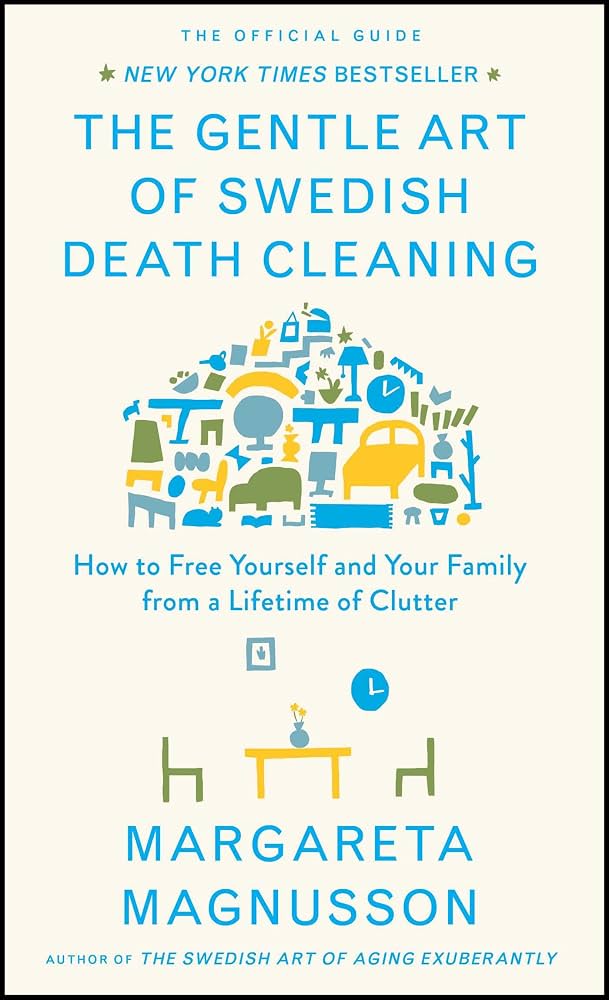
The catch phrase entered the global conversation in 2017 with Margareta Magnusson’s slim, wise little book, The Gentle Art of Swedish Death Cleaning. Magnusson, who described herself as somewhere between 80 and 100, wrote with the dry humor of someone who has moved house many times and buried more than one spouse. Her thesis was simple: don’t leave your mess for someone else to clean up. This came on the heels of Tidying Up, another minimalist concept. But peel back the memento-mori branding and what you find with Magnusson’s book is really a philosophy about presence. Death cleaning isn’t a morbid countdown. It’s a way of asking, continuously: does this object still deserve a place in my life? Swedish death cleaning treats your belongings the way a good editor treats a manuscript — not everything that was once worth keeping is worth keeping forever.
How It Actually Works
Unlike the ruthless, weekend-blitz energy of some decluttering trends, döstädning is unhurried by design. Here’s the general shape of the practice:
-
Start big, start impersonal. Clothes you haven’t worn in years. Extra sets of dishes. Furniture that’s been “temporary” for a decade. These are the low-stakes decisions — good training for the harder ones ahead.
-
Save the sentimental for last. Photographs, letters, journals, your late grandmother’s brooch — these come at the very end of the process, once you’ve built up the muscle for letting go. Magnusson herself admitted these are the hardest categories, and that’s by design, not an oversight.
-
Ask the question that cuts through clutter-guilt: Will anyone be happier if I save this? Not “might this be useful someday” or “did I pay good money for this,” but genuinely — does keeping this object bring joy or ease to anyone’s life, including your own? If not, it’s probably time to let it go.
-
Give things away now, while you can enjoy the giving. One of the most quietly radical parts of this philosophy is the idea that handing down a treasured item while you’re alive — and watching someone’s face light up when they receive it — is a far richer experience than having it discovered in a box after you’re gone.
-
Keep a “throw away” box. Magnusson suggests keeping one box of deeply personal items — diaries, private letters — clearly labeled to be discarded, unread, after you die. Not everything needs to become someone else’s inheritance or someone else’s burden.
It’s Not Just for the Elderly
While the original framing centers on people in their later decades, the practice has found an unlikely following among younger people too — new parents overwhelmed by the sheer volume of stuff that arrives with a baby, people moving apartments in cities where space is at a premium, and anyone who has ever helped clean out a loved one’s home and thought, I don’t want to do this to my own family.
There’s also a quieter benefit that shows up regardless of age: clarity. Going through old belongings tends to surface old versions of yourself — the person who bought that guitar and never learned to play, the wardrobe from a job you no longer have. Death cleaning becomes, almost by accident, a way of taking inventory of who you’ve become.
A Different Kind of Minimalism
Where some decluttering movements can feel aspirational and image-driven — the empty white shelf, the capsule wardrobe as aesthetic — Swedish death cleaning is refreshingly unglamorous. It doesn’t promise a more Instagrammable home. It promises something more tender: that the people who love you won’t have to guess what mattered to you, and won’t be left standing in a room full of decisions with your absence sitting heavy in the air.
The Sequel Nobody Expected: How to Actually Enjoy Getting Older
Having taught the world how to tidy up before the end, Magnusson wasn’t quite finished. In 2022 she published a follow-up, The Swedish Art of Aging Exuberantly: Life Wisdom From Someone Who Will (Probably) Die Before You — released in the UK under the gentler title The Swedish Art of Aging Well. If döstädning was about clearing space, this second book is about what to do with the space once it’s clear. Where the first book was a practical, room-by-room manual, this one reads more like a long, wise conversation with an aunt who has genuinely nothing left to prove. Magnusson — who described her own age only as “somewhere between 80 and 100” — draws on her idyllic childhood on Sweden’s west coast, the fullness of her life with her husband and five children, and what she learned about living alone after decades of not being alone at all.
The book unfolds less like a checklist and more like a series of small, hard-won essays, each built around a piece of advice — some practical, some almost mischievous:
-
Wear the stripes. Don’t be afraid of bold clothing just because you’ve gotten older — Magnusson was famously unwilling to dress like she was disappearing.
-
Don’t fear the future — including the technological one. She encouraged readers to stay open to new technology rather than resist it, treating curiosity as a habit worth protecting well into old age.
-
Keep letting go of what doesn’t matter. The death-cleaning instinct doesn’t retire once the closets are empty — continuing to release what no longer serves you is part of aging gracefully, whether that’s physical clutter or emotional baggage.
-
Start early. Just as with death cleaning, Magnusson insists it’s never too early to begin thinking about how you want to age — this isn’t a project reserved for your eighties.
But the heart of the book isn’t really a list of tips. Reviewers have noted that while Magnusson still champions decluttering, her real message is that we shouldn’t live in fear of death — we should instead put our energy into noticing beauty, staying close to the people we love, and savoring the time we have together. It’s death cleaning’s natural companion piece: having spent one book teaching us how to lighten our load, she spends the next teaching us what to do with the lightness.
The tone throughout is, fittingly, exuberant rather than elegiac. Critics called it a warm, accessible guide to aging with grace — and art, and chocolate, and readers have responded to its gentle, topic-by-topic essays as an undemanding but genuinely heart-warming nudge toward aging well, even joyfully.
One Philosophy, Two Chapters
Read together, the two books form a complete arc rather than two separate ideas. The Gentle Art of Swedish Death Cleaning asks: what can you release, so that your life — and the lives of the people who love you — feels lighter? The Swedish Art of Aging Exuberantly asks the natural follow-up: now that you’ve made room, what will you actually do with it?
The through-line is a kind of unsentimental tenderness that feels distinctly Scandinavian — practical almost to the point of bluntness, but never cold. Magnusson doesn’t ask readers to pretend death isn’t coming, in either book. She asks something harder and more useful: that we stop organizing our lives around the fear of it, and start organizing them around the people, objects, and moments actually worth keeping.
Taken as a pair, the books suggest that death cleaning was never really about death at all. It was the opening move in a much larger project — learning to hold your life loosely enough that you can actually enjoy carrying it.
Feeling inspired to start your own döstädning — or your own exuberant next chapter? Experts suggest beginning small: one drawer, one habit, one bold striped sweater at a time. Small, steady progress beats a single overwhelming weekend — and after all, that’s rather the point.